exploring the relationship between redlining and co2 emissions

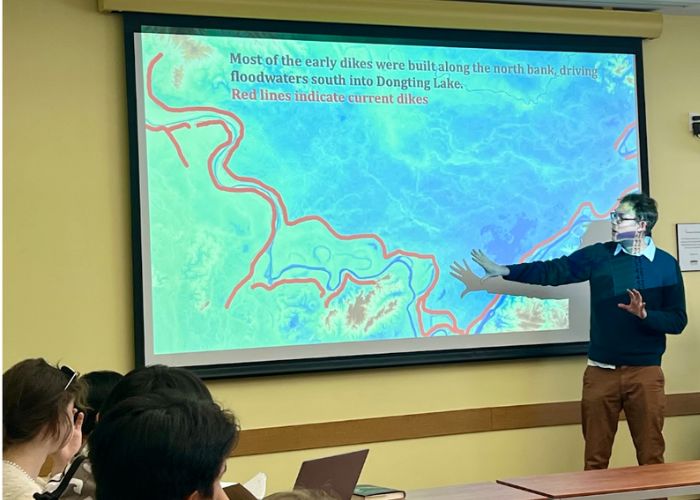
On Tuesday, October 10, Professor Patrick Trent Greiner presented a talk about redlining and CO2 emissions in cities in the United States. The talk was cosponsored by the Bailey College of the Environment, Government Department, Allbritton Center, and African American Studies Department. Professor Greiner is an assistant professor of sociology and public policy studies at Vanderbilt University who specializes in the intersection of structural inequality, development processes, and environmental change. His talk, “The Racialization of Space and the Spatial Differentiation of Emissions,” was an incredible opportunity for students and faculty alike to listen and learn together.

Professor Greiner began by explaining that CO2 emissions must be decoupled from growth and human well-being. Since the preindustrial era, more than 2.4 trillion tons of CO2 has been released and this has been done so inequitably. He reported that the effects of CO2 emissions have been felt disproportionately both across and within nations. 

Greiner then went on to explain redlining and its lasting effects. In the 1930s the Home Owners Loan Corporation, a government sponsored corporation that was created as part of the New Deal to help citizens become homeowners, created maps of neighborhoods. These maps delineated which neighborhoods were safe investments and would get loans, noted as green areas, versus risky neighborhoods, which were color coded red. These decisions were highly racialized and the majority of minority neighborhoods were largely classified as red and, hence, those who lived in these areas were unable to get home loans. Professor Greiner pointed out that this system had many impacts that can still be seen today. 

The main goal in Professor Greiner’s study was to explore the relationship between CO2 emissions in a place and life expectancy. Racial projects, such as the construction of public housing, interstate highways, or redlined neighborhoods, played a major role in this relationship. In fact, using CO2 data from 2010 and 2015, along with redlining maps from the 1930s, Professor Greiner found a clear tie between environmental hazards and racial bias.

In the talk he differentiated between embodied emissions and production emissions. The former refers to emissions created by residents while the latter refers to emissions from companies. He found that there is little correlation between redlined districts and higher embodied emissions but a clear correlation with production emissions. He concluded that redlined areas had lower life expectancies and drew connections between the effects of particulate matter in the air due to emissions and health problems in citizens.

mobilizing power event focuses on community building for enviro justice

The Robert F. Schumann Institute of the Bailey College of the Environment was honored to host Mobilizing Power: Community Building for Environmental Justice on November 11, 2023, in Daniel Family Commons in Usdan. The event brought together advocates from a variety of nonprofits, government agencies, grassroots campaigns, and academic institutions to exchange ideas for making meaningful, long-term environmental progress.  The event was sponsored by The Robert F. Schumann Institute of the Bailey College of the Environment at Wesleyan University, Wesleyan Sustainability Office, Save the Sound, Sunrise Wesleyan, Wesleyan Environmental Solidarity Network (ESN), Sustainable CT, The Rockfall Foundation, and the DEEP.

Organized by Malana Rogers-Bursen, project coordinator for food security, environmental justice, and sustainability for the Robert F. Schumann Institute of the Bailey COE, Mobilizing Power brought together approximately 90 participants, including environmental justice leaders, high school youth organizers, and college students from Wesleyan and other universities, to discuss important issues related to environmental justice in Connecticut. The planning team for the event included community leaders from Sustainable CT, CT DEEP, Save the Sound and the Rockfall Foundation, as well as student leaders Dylan Campos ’24, Michael Minars ’25, Debbra Goh ’24, Hannah Phan ’25, Laine Gorman ’25, and Naysa Abraham ’26, who took clear leadership shaping the event and presenting throughout the day.

Read more

meet our 40+ summer 2023 fellows!

Every year, the COE awards fellowships to fund summer (and spring and fall) research opportunities for Wesleyan students across all majors and class years. Most recently, the COE awarded more than 40 fellowships to Wes students. Learn a little bit more about each, below! Applications for summer 2024, fall 2024 and spring 2025 Bailey COE fellowships will open in January 2024.

Read more

weiner ’24 explores 1947 texas city disaster

Arlo Weiner ‘24 is a history and Middle East studies major. For his thesis, he is creating a documentary about the 1947 Texas City Disaster in which 576 people were killed and more than 3,000 injured. With the assistance of a 2023 Bailey COE summer fellowship, he spent his summer in Texas City and Galveston, meeting with witnesses of the disaster and conducting historical research. 

What led you to choose the Texas City Disaster as the subject for this documentary project? 
I picked this project because I was able to get in touch with a man named Carl Trepagnier, who wrote a fictionalized account of his experience of the disaster entitled Rise Up: A Novel about the 1947 Texas City Explosion. He offered to bring me to the town and offered to show me around and introduce me to other people who also lived through the disaster.

Read more

andrews ’24 retraces her great-grandfather’s farming footsteps

Every year, the Bailey COE awards fellowships to fund summer research opportunities for Wesleyan students across all majors and class years. Most recently, the COE awarded 35 summer fellowships and 1 fall fellowship to Wes students. Olivia Andrews ’24 is an art history major with a minor in film. Olivia’s summer fellowship project mainly centered around her great-grandfather, Tony Andrews, a black farmer who emigrated from Cape Verde by boat in 1926 and founded the family’s farm in Cape Cod, Massachusetts.

Read more

senior spotlight: dylan campos ’24

Our 33 class of 2024 ENVS linked majors have primary majors in 15 different departments, from film to government to feminist, gender and sexuality to chemistry. This diversity reflects the deep and widespread interest in environmental issues on the Wesleyan campus and our incredibly fertile coexist community! Dylan Campos ’24 (he/they) is a history and environmental studies major with a minor in global engagement. Learn more about Dylan, below!

Read more

angstadt ’25 digs coe summer fellowship opp

Every year, the Bailey COE awards fellowships to fund summer research opportunities for Wesleyan students across all majors and class years. Most recently, the COE awarded 35 summer fellowships and 1 fall fellowship to Wes students. Natalie Angstadt ’25 is a junior majoring in Archaeology and Neuroscience & Behavior. Last summer she engaged in an archaeological dig at Trasimeno Archaeology Field School with the Umbra Institute in Perugia, Italy.

Read more