Congratulations to the class of 2021! Read on for more about some of our 31 class of 2021 ENVS majors!
Sanya Bery: My thesis title is A Walk in the Neighborhood: Exploring the Crucial Role That Small Municipalities Play in the Face of Climate Change. Super excited to announce that I will be joining the University of Michigan-School for Environment and Sustainability’s master’s program, with a concentration in Sustainability and Development in Fall 2022. Thank you so much to everyone who has helped me reach this point in my life. I’m thrilled for the adventures that this coming gap year holds and for all to come in the future!
Liana Biasucci: My capstone is an essay called How to Build Back Better: Greening the Recovery from COVID-19, about using government stimulus packages to advance climate mitigation in the US and combining economic goals with environmental ones. Next year I’ll be working in DC doing sustainability consulting. What I’ve learned most from ENVS is how multifaceted environmental problems are and that to have true solutions we need to look at all impacts of policies and actions.
 Lizzie Edwards: My senior essay title is Politics of Thirst: Privatized Water, the Shadow State, and Citizenship Claims in Jordan. My essay examines the different water realities of residents of different socio-economic classes within Jordan. I argue that water has become a key medium in which state responsibility is being privatized and relationships to the state are being negotiated. I will be a member of the CBYX for Young Professionals cohort for 2021-2022 academic year! This fellowship is a fully-funded public diplomacy program through the U.S. government and German government that is offered to 75 Americans every year. I will be studying German intensively for two months, taking college classes in Arabic and migration studies (most likely in German) for a semester, and interning in the field of refugee resettlement for five months. I hope to learn firsthand how organizations in Germany are welcoming refugees and immigrants as well as combatting anti-refugee and immigrant sentiment. From being an ENVS linked major, I’ve learned how to more adeptly discuss environmental issues in an interdisciplinary space. My advice for future ENVS classes is to take classes outside of their comfort zones.
Phoebe Landsman: In my project, Combatting Politicization and Polarization: Re-Framing Climate Change to the American Public, I researched ways to re-frame climate change to appeal to the American public and combat the stagnancy surrounding climate policy in the United States. After graduation, I will be working for an immigration law firm in Boston! I love that everyone comes into the ENVS major with different interests and approaches to environmental studies. I have truly learned so much from my classmates and teachers.
 Every year, the COE awards fellowships to fund summer research opportunities for Wesleyan students across all majors and class years. Introducing our 33 COE 2021 summer (and a few fall) fellows. Read more about their projects, below!
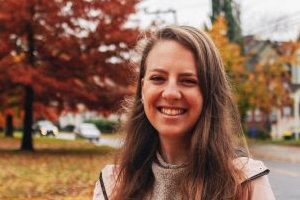 Melissa Thornton ’20 is a current College of Environment Think Tank fellow from Atlanta, Georgia, and a winner of this year’s Sophie and Anne Reed Prize for best poem or group of poems at Wesleyan. A double major in the COL and French Studies, Melissa shared her thoughts on the importance of poetry in times of chaos.
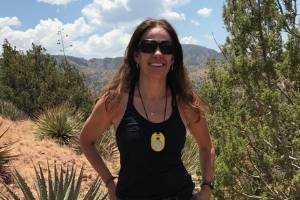 Dr. Helen Poulos, adjunct assistant professor of environmental studies, has been awarded a $300,000 NASA grant to examine forest type-conversion through the lens of evapotranspiration (plant sweat) in response to high-severity wildfire in southeastern Arizona. Poulos and her team will conduct their research using imagery gathered by the ECOSTRESS sensor mounted on the International Space Station. It will be the first-ever test of the ECOSTRESS sensor’s applicability for wildfire-related research.
 The Posse Veteran Scholars Program identifies talented veterans interested in pursuing bachelor’s degrees, and places them at top tier colleges and universities, where they receive four-year full scholarships. Each year, Wesleyan accepts a “posse” of 10 veterans.
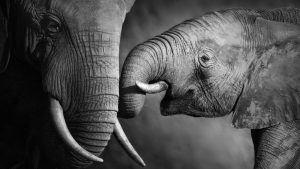 Meaning and language are commonly thought to be the exclusive province of humans. But is this thinking simply our own anthropocentric conceit? On November 2, 2019, Menakka and Essel Bailey ‘66 Distinguished Visiting Scholar in the College of the Environment Charles Siebert led a discussion about the nature of meaning in the world, the myriad of forms in which it manifests, and the many ways in which they inform our place in the world. The discussion, What on Earth Are They Saying: Listening and Learning Beyond the Human, was the 17th Annual Where on Earth Are We Going? seminar sponsored by the Robert F. Schumann Institute of the College of the Environment.