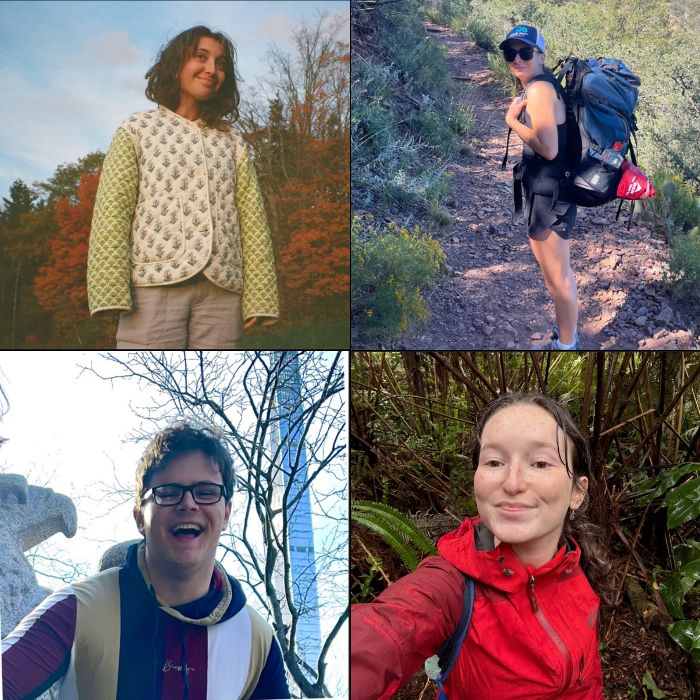
Environmental studies (ENVS) is the academic component of the Bailey COE. Offered as a linked major or minor, all ENVS linked majors have a primary major (or majors) in another academic department or program. So linked equals more, not less! Our current and past students hail from almost every single department and program at Wes: from government, art, and chemistry to economics, English, and earth and environmental sciences to film studies, sociology, and biology!
As we congratulate and wish all good things for our Class of 2026 ENVS majors, check out how the ENVS major can be linked across natural sciences, social sciences, and the arts and humanities, while learning more about four of our amazing graduating seniors (starting top left, above): FILM/ENVSmajor Chloe Andersen, PSYC/ENVS major Rachel Masterson, STS/GRST/ENVS major Isaac Ostrow, and E&ES/ENVS major Catherine Auerbach!
Hi, all! What’s your major/s and why did you choose to link ENVS with your major/s?
Isaac Ostrow: I’m an Environmental Studies, Science & Technology Studies, and German Studies triple major! I wanted to have a broad understanding of the social, political, and environmental issues that will shape the climate crisis and our response to it, and Environmental Studies was the best place to do so!
Chloe Andersen: I’m a film studies and ENVS major. I wanted the opportunity to pursue both passions independently of each other however I have found a lot of crossover in using film as a tool for community engagement and awareness about environmental topics.
Rachel Masterson: I am a psychology major, and I chose to link ENVS with this major, as I am interested in how promoting place attachment can promote pro-environmental behavior, and how experiencing unprecedented environmental degradation effects the publics mental health. I think that these two subjects are becoming more and more intertwined, and understanding how people experience and respond to the growing stress of environmental degradation is increasingly important in a world where no one is untouched by the effects of our changing climate.
Catherine Auerbach: Earth and Environmental Sciences. I chose to link ENVS with E&ES because I wanted a well-rounded background in both the hard science and the societal implications of environmental issues.
How has your experience as an ENVS-linked major shaped your time at Wes or how you think about your primary major/s and/or the world?
Isaac: The ENVS linked major has allowed me to cast a wide net and focus on the human side of the climate crisis, rather than the scientific one. I understand the climate crisis as a social problem, and not a scientific one, and the chance to study history, government, and renewable energy technology, among other topics, has allowed me to focus my STS degree on the climate crisis.
Chloe: The ENVS major taught me how to think critically about a wide range of interdisciplinary topics. As someone who is not stem oriented, environmental studies was an amazing opportunity to pursue an interest without the barrier of foundational math or biology courses.
Rachel: I have loved this major, which is evident in how I finished the major requirements by my sophomore year and continued to take classes. I have taken classes cross listed in biology, anthropology, English, history, computer science, and more. Through these classes, I was able to bring a nuanced world view and environmental focus to my psychology classes, as environmental science and sustainability is inherently present in contemporary psychology.
Catherine: The ENVS major has provided insight into the social, political, and economic implications of the environmental topics I study in my E&ES classes. The major has also encouraged me to take classes in different departments where ENVS classes are cross-listed, such as in philosophy and economics.
What have been some of your most formative or favorite classes and/or enviro experiences (i.e., clubs, volunteering, activities)?
Isaac: Renewable Energy Technologies with Professor Ostfeld, Marxism and Climate Crisis with Professor Plass, and History of Ecology with Professor Erickson are highlights! Getting involved with Sunrise, ESN, and the Green Fund were awesome experiences at Wesleyan, too!
Professor Erickson, Professor Plass, and Professor Saba have been excellent, insightful professors with a wide variety of approaches to explaining human impacts on and understanding of the environment, and have given me a broad framework for understanding the future of sustainability.
Chloe: My first introduction to GIS was through a NASA-sponsored course taught by Professor Poulos. I found remote sensing to be a really powerful environmental storytelling tool. I have continued to pursue GIS-oriented courses afterwards.
I was a member of the Outing Club sophomore year which welcomed me with open arms after transferring to Wesleyan. We went swimming on Thursday nights, hiked on the weekends and sang at open mics on Wednesday nights. Outing Club offered me a much needed community that was engaged with the outdoors. The following year I lived in Outhouse, the program house that Outing Club is run out of, with 10 other fabulous members. We worked very hard to continue the legacy of getting students outside and off campus.
I also took a really interesting course called Writing the Eco Crisis which introduced me to a wide range of ecological writings and styles to help me find my own personal voice.
Rachel: My favorite classes in the major have been the Injustice of School Food, Introduction to GIS, Fire Ecology and Management, and Cities Facing Climate Change and Environmental Psychology (which I took abroad). In terms of environmental experiences, I have loved researching under Helen Poulos during my junior and senior year, and participating in Wesleyan Food Rescue, a club that works to reduce food waste at Wesleyan and increase food security in Middletown. I was also awarded the College of the Environment Fellowship last summer for my research, which was an amazing experience, and have taken part in many sustainability initiatives on campus.
Helen Poulos has had a really big impact on my academic journey. We traveled to Texas twice for field work, once this summer to study the Edwards Aquifer, and once this past October to study fire ecology in Big Bend National Park. Through our summer research, I was able to write an environmental thesis, and have grown so much as both an environmental researcher and writer. Many other professors, including Professor Caruso, Professor Chernoff, and Professor Cohan have also positively shaped my environmental experience at Wes!
Catherine: I really enjoyed “Averting Catastrophe: Public Policy and Risk Management” with Professor Marc Eisner, as well as Global Change and Infectious Disease with Professor Fred Cohan. My 3.5 years working in the Bailey College of the Environment as part of the Sustainability Office have also been incredibly meaningful and rewarding; I have learned so much while being an Environmental Fellow and a Communications Coordinator, and have made so many great friends.
Professor Anthony Cummings advised my senior thesis about the use of medicinal plants in Amerindian communities in Guyana. Using funding from the Bailey College of the Environment Research Fellowship, I was able to travel with him to Guyana during July 2025 for fieldwork, which was an incredibly formative experience as an environmental scientist. I am grateful for his guidance and support throughout my academic journey.
What areas within environmental studies are you most passionate about right now and why?
Isaac: Looking at the ways in which capitalism dictates environmental policy has been fascinating. Professor Saba’s courses on Imperialism and America, while not right now under the ENVS umbrella, are terrific for this! Understanding how corporate interests will resist climate action and how they might respond more favorably is something that I enjoy learning about.
Rachel: I am most passionate about food security and water security right now. With the current dismantlement of FoodCorps, the temporary shutdown of WIC, and the past proposed shutdown of SNAP during the 2025 government shutdown, I believe that it is more important than ever to understand how the climate crisis has and will increase food insecurity, and what methods can be used to fight food insecurity. With AI data centers using large amounts of potable water to cool down their systems, and many parts of the South currently facing unprecedented drought, I believe that it is more important than ever to fight for water conservation and fair use for all.
Catherine: I am most passionate about climate change mitigation, ecological restoration, and wildlife protection. So many ecosystems around the world are on the verge of collapse due to human activity, posing a great risk to biodiversity and the many ecosystem services we rely on. I am hoping to dedicate my career to environmental protection.
What are your plans after graduation (or what directions are you considering)?
Isaac: I would love to work in the renewable energy space in Boston (or remote!). If you or someone you know are even peripherally connected or interested, reach out!
Chloe: I am hoping to work in the film industry for a little while and then possibly pursue a masters in an environmental field.
Rachel: I am going to work as a Water Quality Analyst in New York this summer, and will be pursuing a two year M.S. in Climate Science at Columbia in the fall.
Catherine: I am hoping to work in conservation/environmental restoration, or as an environmental educator, ideally on the East Coast.
What would you tell incoming students who are considering an environmental studies-linked major?
Isaac: The Environmental Studies program here is broad, so having a good understanding of where you want your studies to take you ahead of time can be helpful!
Chloe: Most fields of study are linked to a branch environmental studies in some capacity. I highly recommend the major due to its importance, community, and accessibility to any incoming student looking to double major. Similar to the major’s aim of exposure to variety, I have gained many different perspectives on active student environmental projects through the senior capstone experience.
Rachel: I would tell incoming students to explore as much as they can within and outside of the major, as that is what makes Wesleyan so special. Also, if you have any interest in research, I heavily recommend reaching out to a professor who aligns with your interests, as working in a lab is a great way to get involved with hands-on environmental action.
Catherine: Absolutely do it! The ENVS major has been a wonderful source of community and learning for me, and has encouraged me to take a wide range of interdisciplinary classes. The faculty in ENVS are wonderful and so supportive, and will help you to complete the ENVS major alongside your primary major.
What’s a must-read, must-watch, or must-listen-to piece of environmental media you’d recommend?
Isaac: Climate Leviathan by Andreas Malm and Wim Carton is a must-read to understand the future of climate and government!
Chloe: I recommend the short story Gardening Means War, by Michael Pollan.
Rachel: I really recommend first reading the novel Come Hell or High Water: Hurricane Katrina and the Color of Disaster, and then watching the subsequent documentary which recently came out on Netflix. This novel shaped my understanding of how environmental justice issues are present in all environmental changes and disasters.
Catherine: I would recommend the book Braiding Sweetgrass, by Robin Wall Kimmerer. We read this book in my Environmental Philosophy class, and it really informed the way I think about human-environment interactions.
Congrats to our amazing class of 2026 and newest ENVS (almost) alums: Chloe Andersen (ENVS, FILM), Catherine Auerbach (E&ES, ENVS), Mira Bakshi (CHEM, ENVS), Billy Baumstark (E&ES, ENVS), Robbie Clemens (ENVS,GOVT), Caleb Freiman (ENVS, HIST), Eliana Goldstein (ENGL, ENVS), Rami Hayes-Messinger (ENVS, HIST), Sam Hensinger (ECON, ENVS), Mimi Landes (ENVS, FILM), Tamira Le (CSS, ENVS), Rachel Masterson (ENVS, PSYC), Maxwell Maveus (CSS, ENVS), Shekinah Mba (COL, ENVS), Anna McDonald (ENVS, HISP), Lyah Muktavaram (ECON, ENVS), Zack O’Connor (ENVS, FILM), Isaac Ostrow (ENVS, GRST, STS), Lily Robbins (ENVS, GOVT), Sage Saada Saar (ENVS, GOVT), Lucy Schwalbe (ARHA, ENVS), Ava Symons (ECON, ENVS)!