by Josephine Almond
The Food Justice Adventurers Set Off
In the early morning hours of April 10, a group of Wesleyan students set off to experience local food justice efforts firsthand. At 9 am sharp (a challenging hour for even the best of Wesleyan students), eight Wesleyan student foodies, activists, and explorers, piled into a Wesleyan van, ready to experience local food justice efforts firsthand. The van was expertly piloted by Environmental Fellow and field-trip coordinator extraordinaire Rory, with our other amazing coordinator Jahlani next to him, riding shotgun. We started our day with a healthy amount of networking and granola bars en route to our first stop, Mi Tierra Tortilla.
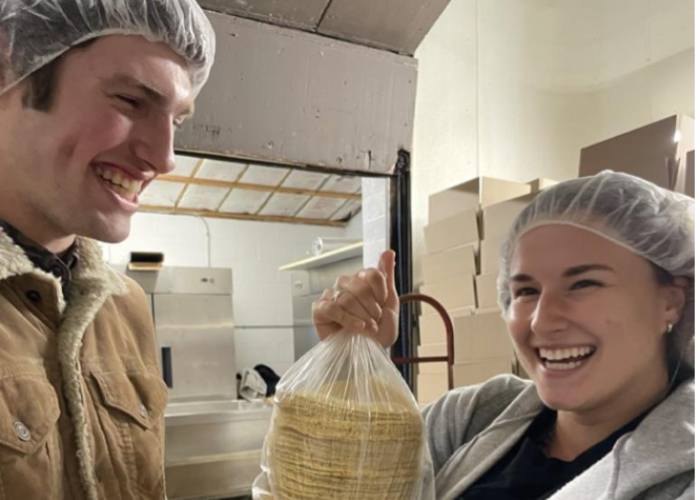
Stop #1: Mi Tierra Tortilla (Springfield, MA)
Mi Tierra Tortilla is one of the Wesleyan dining hall’s local food producers, providing delicious, fresh tortillas for favorite Usdan meals. Michael Doctor, co-owner of the business, met us outside the production room.
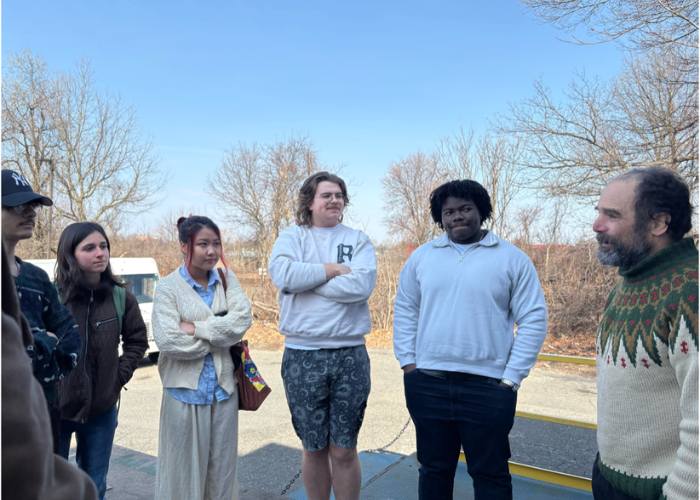
We introduced ourselves, and then Michael ushered us inside, out of the cold, to see the tortilla-making process firsthand. The smell of fresh corn hit us in a warm gust as soon as we passed through the plastic strips forming a windblock in the entryway of the factory.
Passing through the rooms of the factory was a tour through the lifecycle of a tortilla. The first room had a large chute poking out of the wall, which Michael explained was to pump corn into the factory from huge silos outside. The corn is all sourced as locally as possible; Michael, as a former organic farmer, has strong relationships with many local producers. Moving toward the back of the room, we found the source of the intoxicating corn smell: huge metal tubs of boiling corn. Michael explained that the corn is boiled with food-grade limestone, a process called nixtamalization that creates a very alkaline environment to soften the corn. A smaller tub, full of soft cooked corn, stood cooling near the entrance to the production floor.
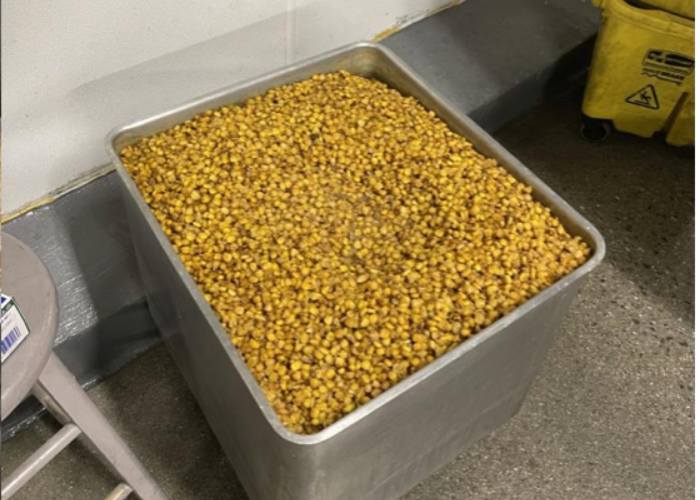
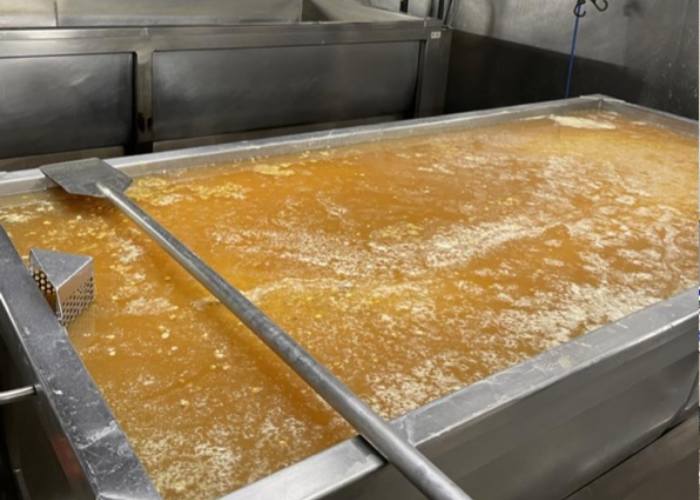
The tortilla production room reminded me of the Rube Goldberg machine. Shiny metal pipes, chutes, industrial-size mixers, and even a couple automated grindstones, took the cooked corn from the previous room on a mechanized journey along one wall and across the back of the room, transforming it from soft kernel to huge globs of sticky yellow dough. Our group adorned ourselves with mandatory hairnets (which we totally rocked) and watched as the Mi Tierra employees fed armfuls of dough into the final tortilla-making contraption, where the dough was rolled out, cut into perfect circles, and conveyed through an oven. There were more than a few gasps of collective wonder as an endless stream of perfectly shaped and cooked tortillas exited out on the other side
Michael let us watch the hypnotic march of the tortillas for a few minutes, before nimbly grabbing us each a steaming hot tortilla to try. They were warm and perfectly soft, with a fresh corn flavor unlike any other tortilla I’ve ever sampled. The only downside of Michael’s generosity? I don’t think I’ll be able to eat them any other way now.
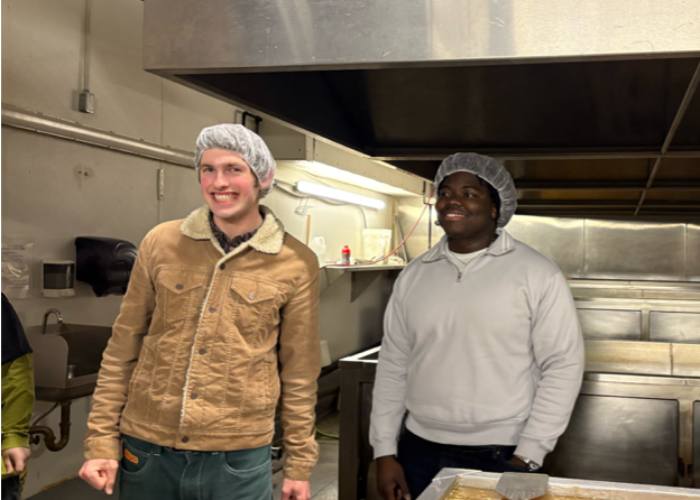
What my taste buds sensed in the delicious tortilla was, perhaps, also, its ability to sustain entire populations of people. Because of the way the corn is processed through nixtamalization, Mi Tierra Tortilla’s corn has highly bio-available nutrients. This way of processing corn into masa and tortillas is why corn and corn tortillas were able to be a staple food in Mesoamerica for thousands of years.
Before sending us on our way (with a ludicrous amount of fresh tortillas), Michael talked to us about the company’s history and partnership with Wesleyan. Mi Tierra Tortilla is a joint venture between Michael and his friend Jorge, who runs a Mexican restaurant in Hadley. Massachusetts. Michael and Jorge realized they were both bothered by the lack of high-quality tortillas in New England and began making their own by hand before deciding to expand to a larger business. They now have partnerships with several universities besides Wesleyan, including UMass Amherst, who serve their tortillas every Tuesday for Taco Tuesday. (Hint, hint, Wesleyan: Where’s our Taco Tuesday?!)
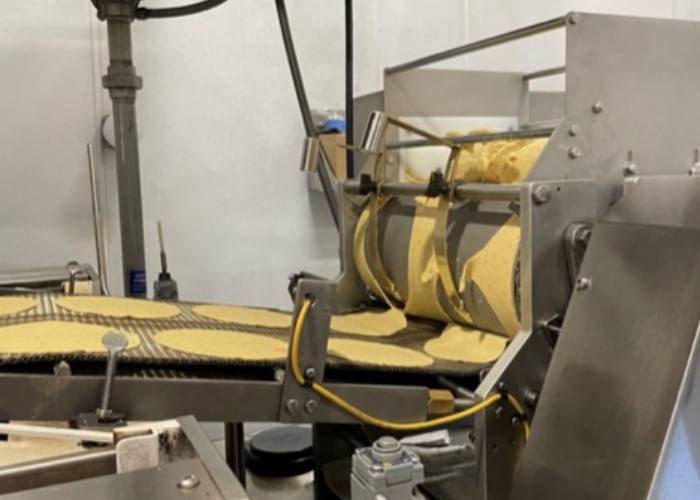
It was inspiring to all of us to see a model of sustainable business that manages to scale the production of delicious, healthy food, without compromising on local ingredients and while minimizing carbon footprint.
Stop #2: Parkville Market (Hartford, CT)
The next stop for our little caravan was Parkville Market, Connecticut’s largest food hall. This marketplace serves as a hub for local food and community events, and features diverse cuisines, from Poke bowls to Brazilian steaks to Peruvian seafood to Mediterranean falafel and shawarma.
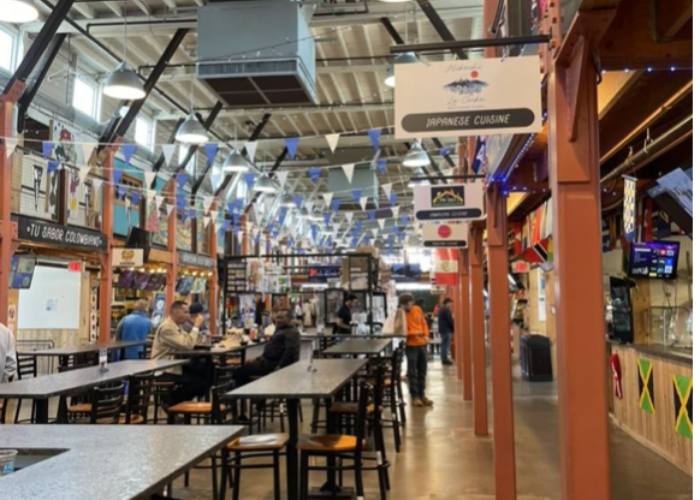
Inside, the market was decorated with the flags of different countries, and the beat of a Badbunny song emanated from the Burrito Loko stall. A temporary exhibit dedicated to the local Trinity Hip Hop festival was displayed on the second floor. We all dispersed to different market stalls, which were set up along either side of the grand hall. While there I admit I suffered from extreme indecision in my choice of lunch, due to the sheer amount of choices at every turn! And I wasn’t the only one. However, in the end, everyone ended up with something very delicious!
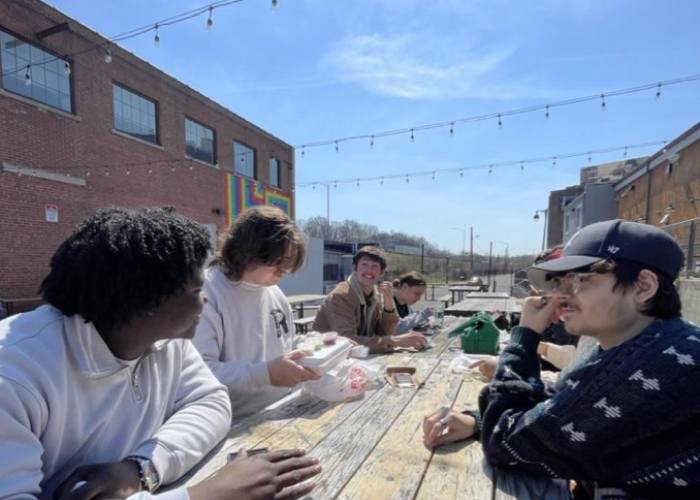
We sat outside at picnic tables in the sunshine to eat, and Malana Rogers-Bursen, who runs Wesleyan’s food justice project, Rooted Solidarity, talked to us about the Hartford area, which suffers from food apartheid. Hartford, despite being the capital city, has been disinvested in, across the board. With high rates of food insecurity, creative food projects make a big difference. If any Wesleyan students are looking for a fun and delicious weekend outing, Parkville Market should definitely be on your list!
Stop #3: Mercado Popular (Hartford, CT)
Our final stop was to the beautiful space of Mercado Popular, just a 5-minute walk from Parkville Market. This local farm store is run by Jocelyn Cerda. You can read more about Jocelyn and her project in the Argus here and on Mercado Popular’s blog.
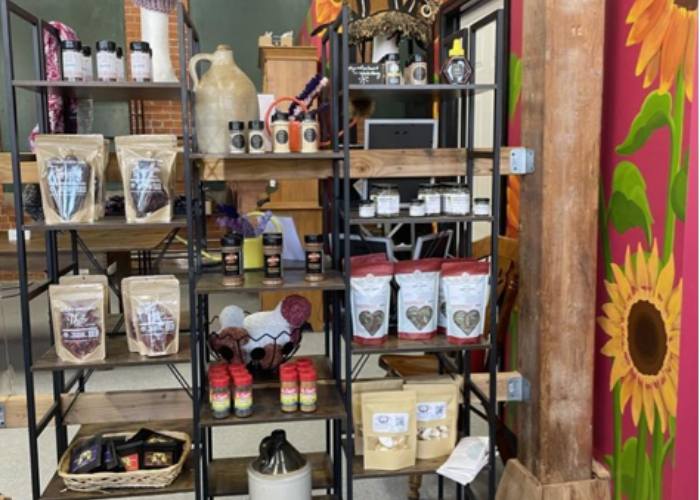
Mercado Popular is an artistic and inviting space, with murals painted on the walls and farm-fresh produce, spices, preserves, and other goodies arranged artfully on a big wooden table in the center of the store floor. Other locally produced goods line the shelves and fridges in the back, from cheese to eggs to pasta to wild rice. Most of the market’s products are sourced from local BIPOC farmers and producers—even the mouth-watering baked goods in a little case next to the register, which are from a Connecticut-based Jamaican bakery.
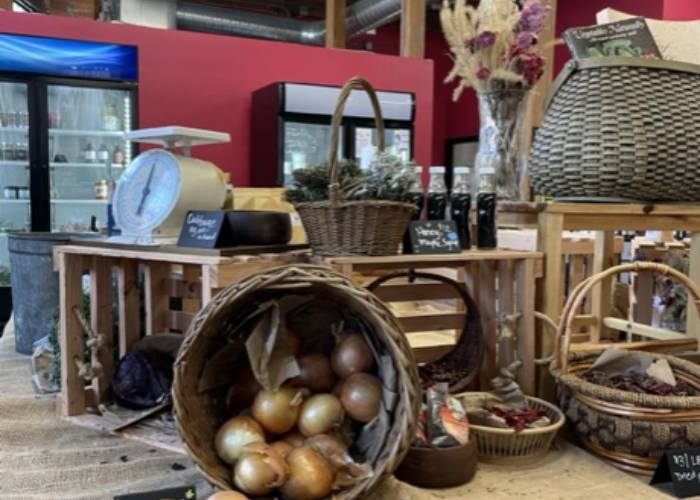
Jocelyn gave us a tour of the rest of the space, which serves as so much more than just a market. There is a back room for skill-sharing, where farmers run workshops on seed-starting, DIY pickling, cooking, and more. In the storage room, Jocelyn holds fridge space for local farmers to store their perishable goods, citing the extreme costs normally associated with cold storage. And outside, just around the back of the market itself, are raised beds: a teaching garden used to grow even more local produce and disseminate farming skills to the community.
All of us were struck by both the depth and breadth of Mercado Popular’s work: how it manages to support people all across the food system, making both the production and consumption of nutritious and local food possible. I really can’t emphasize enough how beautiful and inspiring the space is; I’d encourage everyone reading this to pay them a visit, and don’t skip the vegan oatmeal cookies—which are better than they sound, I promise!
Final Reflections
As we piled into the van to head back to Wesleyan (just in time to make my 1:20 pm class…thanks Rory!), everyone shared reflections on our trip: what had struck them and what they’d learned.
Many people loved tasting the tortillas straight off the assembly line, unsurprisingly. But across the board, people also mentioned that the field trip had made them think differently about Hartford and the local food system in Connecticut. Mi Tierra Tortilla had us pondering how to maintain local and sustainable integrity as a growing business, Parkville Market caused us to think differently about Hartford’s history and overlooked status, and Mercado Popular gave us an inspiring example of the kind of comprehensive local projects that we are excited to support.
We arrived back on campus rejuvenated by good food and better company, ready to continue working for food justice in Connecticut and beyond.