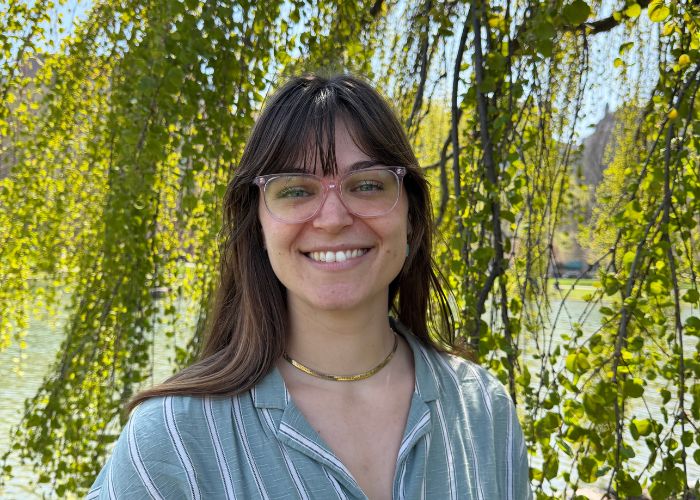
Sage Loomis ‘18 is a food and agriculture systems professional passionate about school meals, food access, and social justice. A biology and environmental studies major during her time at Wes, she is currently a graduate student at the Friedman School of Nutrition Science and Policy at Tufts.
Hi, Sage! Looking back, what part of your Wesleyan experience most prepared you for your career?
One of the most directly relevant pieces of my Wesleyan experience was leading a produce co-op! The experience of working with farmers to source produce weekly and distribute it to the student body was similar to the Community Supported Agriculture work I did a few years later. It also gave me experience in basic budgeting and managing volunteers, which are generally applicable skills! The other experience that prepared me for the work I am currently doing was writing a senior thesis. The ability to read and understand scientific literature and then synthesize it is extremely useful in advocacy work. Also, having good writing skills is invaluable!
What did you learn from managing a large CSA program and working directly with farmers and food systems?
The biggest lesson I learned was about the challenges facing the middle of the supply chain. I started working at a food hub in Hawai’i, Adaptations, in 2021, when COVID supply chain delays were top of everyone’s mind. Hawai’i is a place that is extremely dependent on food imports, and those bare supermarket shelves led to a renewed interest in local food. Because of that interest, it was an exciting time to be at the food hub, as they were rapidly expanding. However, in addition to global supply chain shocks, working at a food hub meant we were the middle link between farmers and customers. This gave me an appreciation for everything that must happen to get food from the field to your plate. Transportation and cold storage can seem like less exciting parts of the food system, but improving this messy middle could have a really big impact! Working for a food hub also gave me a greater understanding of the challenges faced by small farmers and consumers and gave me a better sense of how the whole system does and doesn’t function. This experience has continued to spur my interest in using policies to address issues facing the entire supply chain.
What motivated your transition from on-the-ground food systems work to policy and research?
Right after I graduated Wesleyan, I joined FoodCorps, an AmeriCorps program, where I worked teaching gardening and food-based lessons with elementary schoolers. I loved working with kids, and it was so rewarding to get them excited about eating vegetables and trying new foods, but this experience deepened my understanding of the structural barriers that impact a school districts’ ability to improve food options, as well as food access barriers that families face. I also saw how federal policy like the Healthy, Hunger Free Kids Act improved healthy food options in schools. Combined, this got me interested in the bigger picture solutions that policy can provide. After several years of engaging with state and local policy on my own, I decided there were skills I could only gain with further education and made the decision to go to graduate school.
Can you talk about your work on food access issues like SNAP or dollar stores?
The dollar store research I have been working on has been really interesting. Essentially, dollar stores started selling food items around the Great Recession in 2008, and since then, an increasing number of people have begun to utilize them as a grocery shopping destination. However, because the foods they sell tend to be unhealthy, and lack fresh produce, a lot of municipalities are putting in place zoning restrictions about where dollar stores can locate, or restrictions that they have to offer a certain amount of produce. But the research we have been doing shows that food purchases at dollar stores are healthier for people that purchase more food at dollar stores, compared to food purchases from people who are buying less at dollar stores. People are likely shopping around trying to find the best deals for things they are already going to purchase. The story is also complicated by the fact that dollar stores tend to be set up in communities where grocery stores won’t locate, so dollar stores might be an important place to access food for people. Basically, how dollar stores are impacting healthy food choices and food access is complicated! Getting down to the root of the issue, instead of relying on assumptions, has been an exciting part of contributing to this research. And in a time of increasing food price inflation, and as more people turn to dollar stores for food purchases, it feels extremely relevant.
What led you to pursue your master’s at Tufts?
I knew about the program at Tufts for several years before applying, but what ultimately drew me to the program was the interdisciplinary food systems focus. I could have gotten a Public Policy or Public Health degree, but I knew that I was interested in food systems work and felt like the Tufts program would allow me to gain policy and public health experience through the lens of food.
How has graduate school deepened or shifted your interests within nutrition and food policy?
I came into graduate school focused on issues of food access, and I am still passionate about that issue, but I have become really interested in solutions that work to solve multiple issues in the food system at once. There is an increasing focus on institutional purchasing, for example, which can improve healthy food options while also supporting the local farmers. Graduate school gave me the tools to look beyond the simplest solution, or the existing solutions, and to think about what other levers we can pull to initiate change.
What gives you hope in this field?
In this time when everything at the federal level feels like terrible news, it is the innovative local strategies that are especially inspiring to me. As states and municipalities must do more with less, there is a renewed focus on decreasing the inefficiencies in our food system. For example, there is a lot of movement on decreasing food waste as a way to redirect food to those who need it and improve environmental outcomes. While the cuts at the federal level are really devastating, I think it has inspired creativity at other levels. Also, food systems issues are getting a lot more attention, and people are really recognizing the importance of improving our food system to meet environmental, health, and equity goals. Back when I graduated Wesleyan, food systems and food access weren’t terms you heard very often, and now they feel more commonplace. I think this opens up a lot of areas for young, creative people to get involved and work to fix our system, which gives me a lot of hope.
For current Wes students interested in environmental studies or food systems: Where should they start?
First, I want to say that it’s never too late to start or get involved! Second, I think working in both food systems and environmental studies is fantastic because you can connect these issues to your other interests. I became passionate about food systems work because it combined my interests in environmental studies and social justice, but food can be connected to health, culture, community building…whatever your interests are! So, I recommend starting with your other passions and then considering how they relate to food systems or environmental studies. Wesleyan will have the opportunities for you, no matter what you’re passionate about!
What’s one thing you wish you had known when you graduated?
I wish I better understood how to give myself grace in figuring everything out. When I look back on my path after Wesleyan, it seems very linear, but at every step of the way I had doubts about whether I was making the right decision. Environmental studies and food systems work are incredible in that you can connect these issues to other things you are passionate about, but that flexibility can feel overwhelming when deciding where you want your career to go. Just know that you can always change directions, and nothing you do will ever preclude you from switching paths. I think it is always easy to look at what someone else has done and assume they have it all figured out, but we’re all still working it out!