By Laura Bither ’18
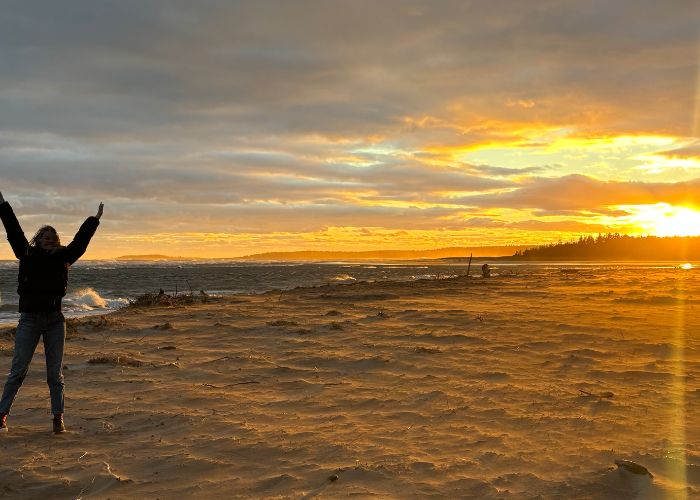
Laura Bither ’18 graduated from Wesleyan with a degree in environmental studies and biology, with a minor in African Studies. She is currently director of JustME for JustUS, a nonprofit organization with a mission to invest in Maine’s young leaders to create lasting power for their rural communities and the natural environment. Laura shares her journey from Maine to Wes and back to Maine, below!
Whenever someone asks me why I chose Wesleyan, I always have the same response: I felt that it would shape me to be the person I wanted to become. While my exploration took a few turns, I double-majored in Biology & Environmental Studies with a minor in African Studies. My passion for climate justice has been a core part of me since I was 11 and I had a moment of clarity that I wanted to be an “environmentalist” when I grew up. It was only when I got to Wesleyan and learned about climate justice that everything clicked into place. Fall of my freshman year, I took the AMST Intro to Pop Culture and Social Justice course and it blew my mind. I had no idea how all social issues intersect with climate, and learning case studies about the Lower Ninth Ward and environmental racism was the spark that solidified my passion.
I’m so grateful for the diversity of work experiences I had on campus, and the privilege to get to explore and learn through those roles. I see pieces of those experiences showing up in my work now: divest organizing on campus, the Eco Facilitator program, and mentoring my peers as a writing tutor. I also had the special honor of working in Barry Chernoff’s lab with my best friend and spending summers on the Connecticut river leading fish surveys…but my time revolves a lot less around fish genetics these days.
Something that gets missed in my resume is a formative major concussion I sustained a year after graduation while I was playing ultimate frisbee. I was working as an AmeriCorps VISTA at a nonprofit expanding access to public benefits, financial education, and affordable housing in Chelsea, MA. I loved the city and the community power I saw there, but my time in that role felt frustrating due to my lack of agency and inability to create meaningful change. I also felt a deeply renewed call to find climate justice work. That concussion upended any plans I had in my head. I went on a six-month backpacking trip with my friend (inadvisable with a head injury, in hindsight), COVID hit, and I was grateful to be able to move home with my family to recover. Ultimately, I was out of work for two years.
Back in the place I grew up at a time when the world was more isolated than ever, I fiercely sought to build community in the place that raised me. Along with some local community organizing and volunteer work, I started working as a Summer Community Organizer for the Maine Environmental Education Association. Humbled and extremely grateful to be in that summer position at age 25, I had my first experience with an organization that, I felt, practiced climate justice in the way that I believe it should: youth-centered, intersectional, and justice-oriented. When the other summer fellows left to return to college in the fall, I wanted to stay on in some way. That’s when I found JustME for JustUS.
About a year old, JustME for JustUS, or JMJU, was, at that point, a small program of the Maine Environmental Education Association. I started off as a Youth Organizer, building out JMJU’s network and presence across two of Maine’s most rural coastal counties. As my capacity to be on screens and other concussion symptoms improved, I had the privilege of growing JMJU, and growing alongside it. We now have 15 Rural Youth Organizers based across nine of Maine’s northernmost rural counties who are leading deeply meaningful and thoughtful work in their communities.
JMJU’s mission is to invest in Maine’s young leaders to create lasting power for their rural communities and the natural environment. Our team of youth organizers (ages 15 to 30) create campaigns around climate justice in relatable and plain terms, organizing around issues such as Wabanaki sovereignty, access to healthy and affordable food, transportation, and mental health. We lead year-round civic engagement work to tie concerns to action, from pushing for priority bills during the state legislative session to turning out at school board and town council meetings. During even election years (like this one!), we lead nonpartisan vote work to ensure that young people have a voice in decision-making. In deeply polarized times and spaces, we aim to bring young people together across political divides to take action. What that really looks like is a network of incredibly passionate young people working together to create youth-led change and stepping into opportunities to lead and make decisions that may not exist in traditional environmental spaces.
An example that stands out to me is one of our long-time organizers, Isi, who had been leading a series of Community Resilience Envisioning events that brought community members together for panel discussions, food, dance, and collective visioning around what a thriving, resilient future could look like. After two successful events in different regions, she aimed to expand to a third in a small coastal fishing community.
After meeting with town leaders, she received feedback that the community was frustrated with outside environmental groups coming in and telling them what to do (a common sentiment across many of our rural communities). That’s where her approach really mattered. She pivoted, drawing on local relationships to redefine what resilience envisioning could look like. Instead, she partnered with several local organizations to lead a weeklong STEM program at the high school, focused on redesigning the causeway connecting the island to the mainland, as well as other infrastructure damaged by severe winter storms. By reframing climate solutions as hands-on, career-connected learning opportunities with engineers and architects, we were able to respond directly to an urgent community need while still addressing climate.
I’m so grateful to be leading work that gives me so much freedom for creativity and variety. My day can include administrative and operations tasks like getting our team and volunteers paid (an equity measure to remove barriers to attending our events), meeting 1:1 or as a team with my organizers, brainstorming communications strategy with my year-round core team members, writing grants or prospecting new donors, forging new partnerships and meeting with other organizations or in coalition meetings, meeting with our Board, or going over our taxes and bookkeeping. Recently, I’ve been excited about exploring more deeply equitable systems and structures for us to formalize in order to address power dynamics, have equitable decision-making and feedback structures, and ensure that everyone’s voice is heard.
In these highly polarized and politicized times, I stay grounded in gratitude for the incredible youth organizers I work alongside. We celebrate small wins and meaningful interactions that sustain us. I’m proud to help build a more inclusive democracy and believe our relationships are stronger than the vitriol and fear that divide us…and that we have more in common than it may seem. While federal work can feel disheartening, I find real hope in the power of local and statewide change, and in the energy and commitment of young people across our network
While at Wesleyan, I put so much pressure on myself to figure out what I wanted to do for a career. My advice to current students would be to trust your gut in your exploration. Try things out…and don’t be afraid to build something, if you’re not seeing what you need. That’s advice from my dear friend and JMJU’s co-founder, Chloe, who went on to create another very cool rural democracy organization. It has been so empowering to realize that you can build out an organization with a 32-hour work week, healthcare, and a sharp commitment to equity coupled with commitment to always be learning that aims to truly replicate within the organization the change you want to see in the world. We definitely need more organizations joining this trend for culture shift, and Wesleyan grads can do it!
I’ll leave this reflection with this article: Returning Land to Tribes is a Step Towards Justice and Sustainability, Say Wabanaki, Environmental Activists. The Wabanaki are the only Indigenous people in the United States that do not have access to federal benefits or sovereignty due to the 1980 Maine Indian Claims Settlement Act, a truly remarkable injustice that still persists in a state often celebrated as a climate leader. This 2022 Harvard report outlines some of the very real economic and social consequences of that legislation. This piece also features quotes from some incredible activists, thinkers, and movement builders in Maine around land return and what that actually means and looks like in practice.