by Basak Kus, Tim Sahay & Mitali Thakor
As part of our Bailey COE Think Tank’s ongoing work on disruption and futures that feel increasingly unpredictable, and more dystopian than hopeful, we (Basak Kus, Mitali Thakor, and Tim Sahay) headed to Mexico for a three-day excursion. The trip was short and intentionally dense. Curated by Tim and Mitali, it involved speaking with people working on climate policy; visiting one of the most discussed municipal experiments in contemporary urban governance—the Utopias initiative, created under the leadership of Mexico City’s widely popular mayor, Clara Brugada; and, last but not least, meeting with the esteemed scholar Paula Ricaurte, whose work on technology, power, and AI has been formative for Mitali’s thinking. As we took off from JFK, we were excited about what lay ahead.
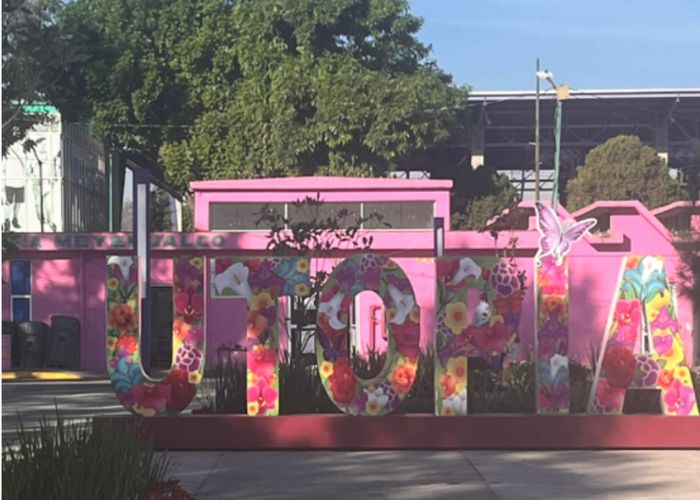
None of us were unfamiliar with Mexico City. Each of us had visited this magical place multiple times before, for both work and pleasure. Yet this visit felt different from the moment we arrived. We arrived with plenty of questions—questions about climate adaptation, urban governance, and technological power—and those questions altered how CDMX engaged us, as a series of arguments about possible futures.
By the end of the trip, it was clear that what inspired us most was Mexico City’s refusal to accept the terms on which crises or challenges of our times are often discussed. Where many futures-oriented conversations in the Global North oscillate between techno-optimism and profound despair, the initiatives we encountered here felt brave but also grounded, insisting that alternatives can be built and must be built even when the future feels unpredictable and dystopian.
First stop: Utopias
Conceived initially in the borough of Iztapalapa and later scaled across Mexico City, the Utopias are a model of urban social policy that treats public space, leisure, care, and culture as core elements of social citizenship rather than auxiliary amenities. They are located in neighborhoods that have historically been excluded from sustained public investment. Rather than narrowly conceived social centers designed to deliver discrete services in a modular fashion, they articulate a broader feminist vision of what it means to live and flourish in a major city.
When we walked in the open gates, we were greeted by two staff members who would serve as our guides for the day. The lush entrance and vibrant pink and yellow buildings offered a calming reprieve from the bustling Mexico City streets. They patiently led us through the entire space: a music school, an Olympic-sized pool, a physical therapy room, a kitchen, a childcare center, a hot pool, a gym, and a dinosaur park, explaining the operations and vision as we moved from one area to the next.
The experience was a welcome sight to our sore eyes long accustomed to US neoliberal urbanism: a model that, since the late twentieth century, has steadily withdrawn public provision, privatized urban services, and reorganized city life around commodification, real estate valorization, and fiscal discipline. The Utopias invert this spatial and political logic. Where neoliberal urban policy frames recreation and care as private goods to be purchased in the market, Utopias treat them as unconditional elements of urban citizenship.
Tim had long been familiar with the Mayor Clara Brugada’s Utopias initiative, and her radical vision of a feminist economics. For Mitali and Basak, this was a discovery. We learned that Brugada emerged from decades of grassroots organizing in Iztapalapa—one of Mexico City’s most populous and historically marginalized boroughs—and built her political career by advocating for a governing style grounded in redistribution and the expansion of public infrastructure. “A feminist city,” writes Clara Brugada, “must be committed to the rehabilitation of public spaces, building a safe environment for women in which they can move freely and fearlessly.”
As we walked through this beautifully imagined space admiring what we encountered and sensing the pride and commitment of the staff who clearly believed in the project and in the mayor who brought it to life, we could not help but think about how our political spaces in the United States fail to deliver not only projects like this, but even the capacity to imagine them. That realization, our poverty of imagination, perhaps more than anything else, felt deeply saddening.
Second stop: Encountering Rafael Cauduro’s art at the Mexican Supreme Court
Our second stop turned out to be the Mexican Supreme Court. This was unplanned. The detour emerged after we accidently came across an exhibition on Mexico’s Dirty War near our hotel. Struck by what we saw on a screen—a video capturing unsettling political murals— we asked where we could see the originals and about an hour later found ourselves inside the nation’s Supreme Court.
The murals, we learned, are the work of Rafael Cauduro, one of Mexico’s most uncompromising contemporary artists, known for a body of work that sits between painting, muralism, and political indictment.
Like the canonical Mexican muralists Diego Rivera, José Clemente Orozco, and David Alfaro Siqueiros, Cauduro works at monumental scale, and his work is displayed in public institutions. But unlike the famous trio whose work speaks to themes like worker exploitation and revolutionary nationalism, Cauduro is an artist of our time who bears witness to state violence and failures of justice. The murals we saw in the Court, installed between 2007 and 2010, are referred to collectively as Los Siete Crímenes Mayores (The Seven Major Crimes). In their portrayal of rape, torture, extrajudicial killing, they accuse power. Judges, clerks, and staff pass daily through scenes that speak to the law’s failure to protect rights and dignity. The Court’s decision to commission and house the murals compels the legal system to coexist with a visual record of its own limits.
Encountering these murals was a powerful experience. On the one hand, we could not take our eyes off them. On the other hand, we felt a deep sense of discomfort- even embarrassment gazing at these raw portrayals of state violence that turn ordinary citizens into prey.
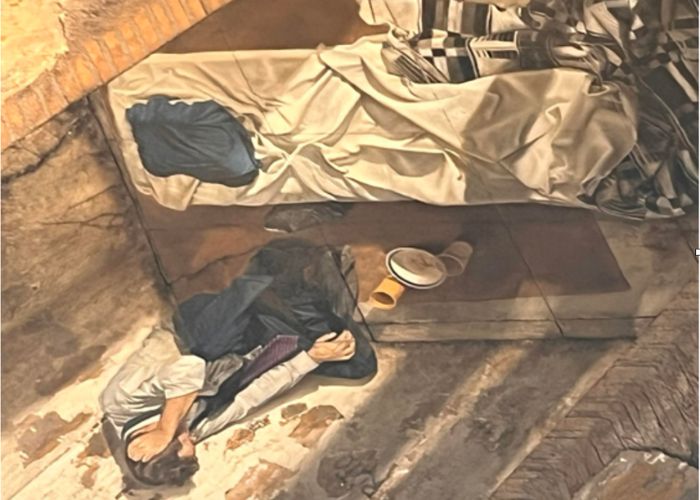
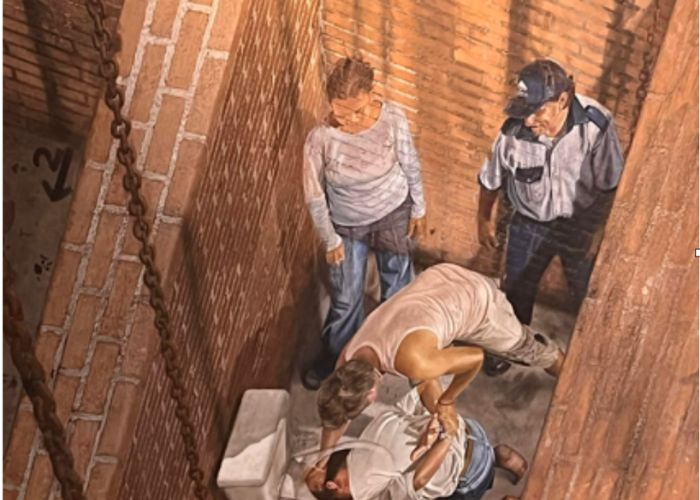
There was something common between the Utopias and the murals, it seemed to us—a concern with dignity, though expressed through radically different means. Where Cauduro’s murals confront state violence against citizens—police brutality and lack of access to justice—the Utopias confront a quieter but equally corrosive harm: the slow erosion of dignity through economic insecurity, neglect, and the absence of public goods. One issues an indictment of the ills of state power used against citizens; the other demonstrates how that same power can serve and provide for them.
Third stop: Dinner with Paola Ricaurte Quijano
Our next stop was to meet the visionary technology scholar Dr. Paola Ricaurte Quijano, a professor in the School of Humanities at Tecnológico de Monterrey and a faculty associate at the Berkman Klein Center for Internet & Society at Harvard University. Paola is also the co-founder of Tierra Común, a network to promote reflection on data colonialism from the Global South. Paola’s lifelong work has been to develop a decolonial and intersectional feminist ethics critiquing what she calls “hegemonic AI” as a tool of neo-imperialism, and turning toward a new praxis and way of being with AI that sustains life, fosters well-being, emphasizes solidarity, and is adaptably responsible to people in Latin America and the majority world.
This re-orientation of where knowledge about AI is produced was why we wanted to meet and learn from Paola. Sitting with her at a leafy cafe in the neighborhood of Coyoacán, Paola explained that she sees current artificial intelligence as a crystallization of Western imperial power exerting violence at global scale through three linked processes: 1) datafication, 2) algorithmization, and 3) automation. Datafication of bodies and behaviors relies on extractive practices that commodify people into data points as well as literal resource extraction of minerals, water, and energy to power the data centers that make AI appear autonomous. Algorithmization reduces people, especially in the Global South, into objects that can be disciplined and controlled via local and global surveillance, from citywide predictive policing algorithms to networks of military and drone infrastructure. And finally, the fantasy of automation (that autonomous tech will set “us” free) belies the inequality and cruelty behind the scenes that make AI work, from the supply chain of global content moderators to the displacement of responsibility that companies shirk from economic to medical decisions.
An Ecuadorian born in Colombia, educated in Spain and Russia, and now working in Mexico, she emphasized that her work ethic emerges from a feminist socialist political tradition with a rich history in Latin and South America. Who is AI for? Who does it serve? How can AI work for the majority of the world?
Listening to Paola, Mitali was reminded of the influential volume Beyond Imported Magic: Essays on Science, Technology, and Society in Latin America, written by a group of Latin American scholars to challenge the prevailing notion that technological prowess, computers, AI—indeed scientific development itself—arrived to Latin America “from elsewhere.” This perception reinforces the idea that the hegemonic West designs and exports its tools to a complacent, receptive Global South.
We left Mexico City unsettled in the best possible sense. The Utopias reminded us that public imagination is itself a political act. Cauduro’s murals reminded us that building dignity and defending it are inseparable- defending it begins with refusing to look away from what destroys it. And Paola reminded us that the tools we build to navigate the future are never neutral, that they carry within them the assumptions, interests, and hierarchies of those who design them. What connected all three encounters was a refusal to accept the world as given and an insistence that the terms on which we discuss crises, cities, and technologies are themselves contestable.
When there was no light,
nor water, nor shade because there was no light
nor water, nor sun because there was no moon
nor oceans because there was no water
nor light, nor trees because there was no
birds, nor sky because there was no earth
nor light, because there was no fire
nor heat, because there was no light,
nor water, nor earth nor fire.
There was a dream
asleep
waiting for the blue of the sky.
by ANA BELÉN LÓPEZ
About Ana Belén López: Ana Belén López, (Culiacán, 1961) is the author of the poetry books: Alejandose avanza, Fondo Editorial Tierra Adentro, 1993, Del barandal, Ediciones sin Nombre, 2001, Silencios, Instituto Sinaloense de Cultura, 2009, and Retrato hablado, Andraval Ediciones, 2013. In 2020, the year of the pandemic, she published Ni visible, ni palpable,part of the collection: El Ala del Tigre, from the UNAM (Autonomous University of Mexico). She is a graduate in Latin American Literature with a Masters in Modern Literature.