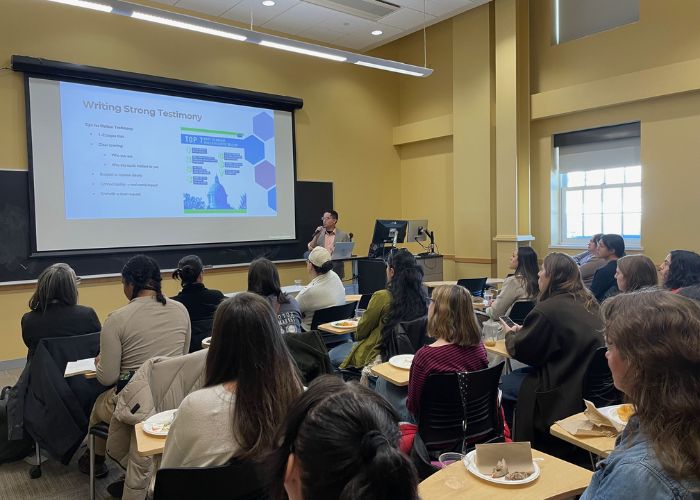
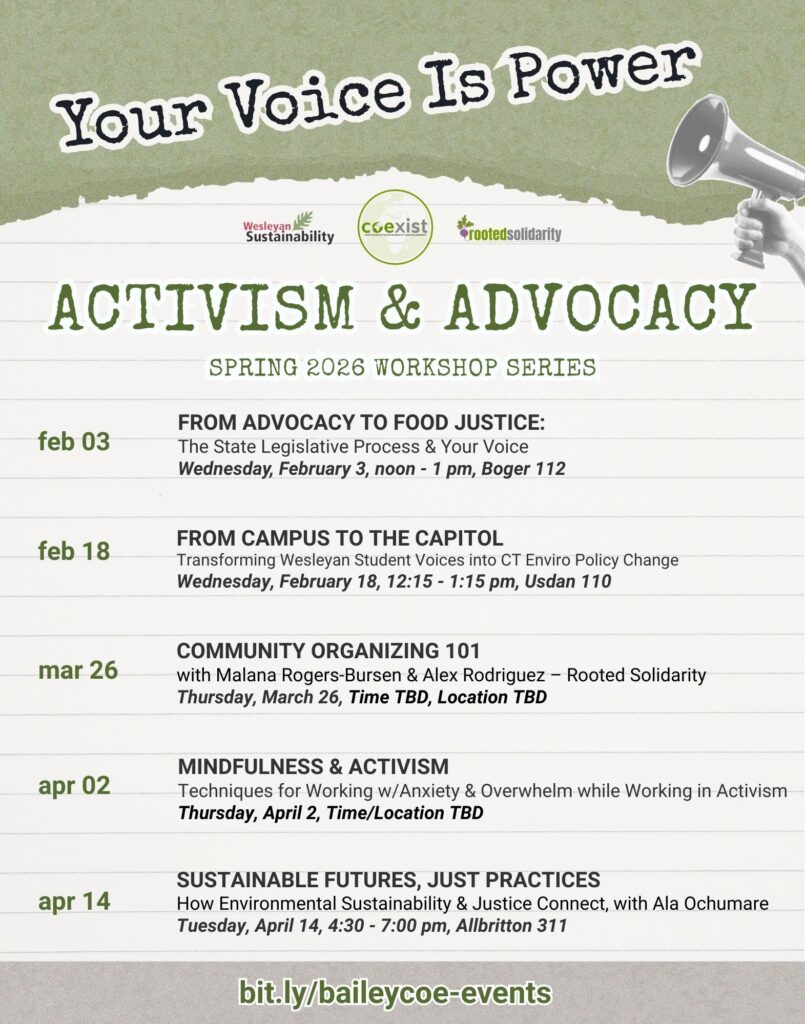
On Wednesday, February 3, Wesleyan was honored to welcome Randall Mel, Jr., director of Wellness and Nutrition Services for Middletown Public Schools, to facilitate a workshop about the state legislative process, food justice advocacy, and how students can get involved. Attended by members of food justice organizations from all across the state, as well as Wesleyan students and faculty, the workshop gave attendees concrete and actionable advice to begin influencing policy in Connecticut. The event was the first in a series of Activism & Advocacy Workshops being held this spring.
Mel drew from his personal experience as a food advocate working in the Middletown Public Schools, as well as with End Hunger CT. He began the workshop by going over the schedule and structure of the Legislature, emphasizing that even during small “budget adjuster” legislative sessions, like 2026, student voices can have a powerful impact on maintaining funding for important programs.
“Consistent and Persistent”
After sharing an online tool to find local legislators, Mel emphasized the importance of cultivating a “consistent and persistent” relationship with your legislator. “You have every right to continue to speak with them throughout the entirety of the [legislative] process.” He told attendees. “Do not just send one email.” Once attendees found and contacted their legislators, Mel advised scheduling an in-person meeting for maximum memorability.
Attendees learned that whether meeting in-person, over email, or on the phone with their legislators, they should always introduce themselves, and, critically, identify themselves as a constituent. Mel also suggested leaning on personal stories, which are more persuasive than raw statistics. His final tip was simply to be clear about what you want your legislators to do; whether that’s co-sponsoring a bill, publicly supporting a budget item, or voting favorably on a certain piece of legislation.
Public Testimony: The Most Direct Tool
In order to influence multiple legislators at the same time about a specific bill, Mel walked workshop attendees through the process of writing and giving public testimony, which he described as “your most direct tool” to shape the outcome of legislation. He encouraged attendees to deliver “speaking testimony” in person at the Capitol building, as there is time allotted for the public’s comments the night before a bill is officially deliberated.
Mel emphasized the impact that young testifiers can have. “[Legislators] love hearing student voices in particular,” he told attendees, recalling the success of a farm-to-school bill that students from Middletown Public Schools delivered testimony in support of last session. “Students have shaped very real outcomes here.”
Unity and numbers are critical for delivering effective testimony as well; as Mel put it, “advocacy is a team sport.” He ended the presentation with a reminder that next year is the Connecticut gubernatorial election, as well as a “big” legislative session for the General Assembly. The implication was clear: growing a “team” of activists is critical not only for current legislative priorities, but also to build momentum for larger political struggles in the near future.
SNAP Concerns & School Food Expertise
After the information-packed presentation, the floor of the workshop was opened for questions from the audience. Many attendees were curious about Mel’s work in the school food arena, asking about the logistics of free school meals and the impact of Federal bill H.R. 1 on Connecticut’s SNAP programs.
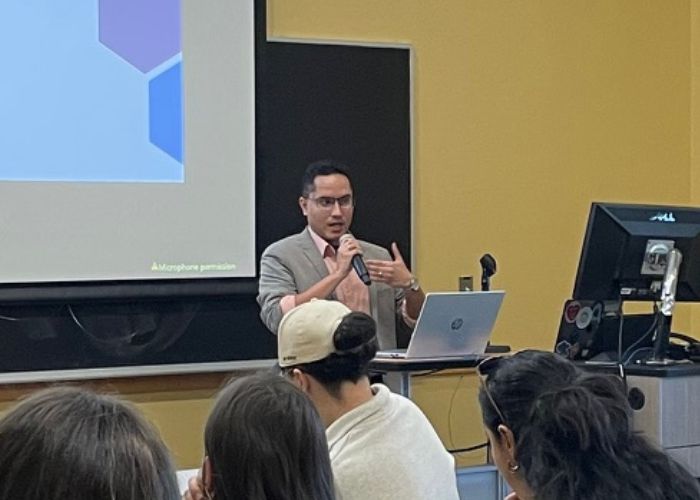
“There are a lot of unknowns we are tracking,” with H.R. 1, Mel told attendees. Community eligibility for free and reduced price school meals is determined by enrollment in federal benefits like SNAP. For the first time, Connecticut may have to pay out of its state budget to keep SNAP programs funded rather than relying on federal funding, putting general food security as well as free school meals programs in jeopardy. However, a potential silver lining in Connecticut is that threats to SNAP are creating a stronger consensus and consciousness about the importance of food access and advocacy. This legislative session, the momentum is strong to demand that Connecticut fully fund SNAP, making up for any Federal cuts.
As Mel’s extensive experience demonstrates, unity and commitment to action works. Though bolstering food justice seems far out of reach at a national level, this workshop reminded attendees that there is plenty of critical work to be done at the local and state level. This work can have a measurable, direct impact on the ability for kids and their families to access nourishing meals.
In this sense, the most important lesson Randall Mel offered attendees was the knowledge that as hard as it is to change everything, it is not hard to change something. Attendees left the workshop ready to fight for the nourishment of Connecticut’s students and communities while nourishing, too, their collective organizing power.