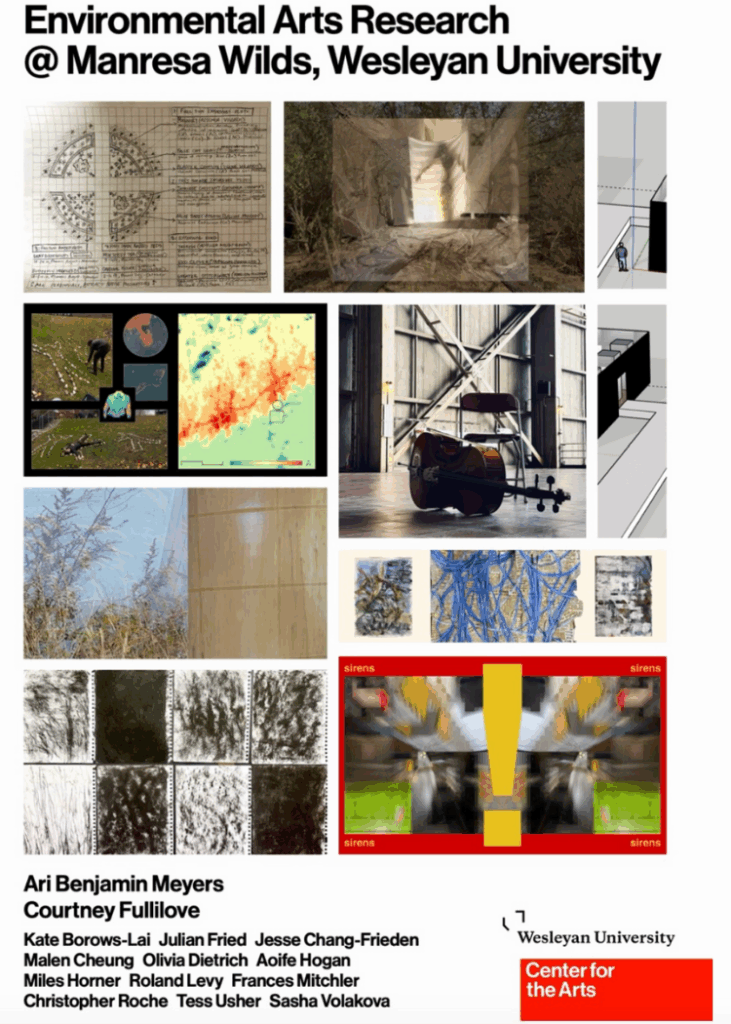
During fall 2025, students and faculty from across Wesleyan pursued a coordinated set of research and creative projects at Manresa Island in Norwalk, Connecticut. The 25-acre island within a tidal marsh system of the Long Island Sound served as a Jesuit retreat in the late 19th and early 20th centuries before being acquired by Connecticut Light and Power for the construction of a coal-fired power plant. Over its 50 years of operation, the plant transitioned from coal to oil and expanded the land mass by roughly 100 acres, largely through the disposal of coal ash and dredge spoils. Since the plant’s decommissioning and abandonment in 2013, the island has developed an urban ecology marked by remnant industrial structures, an early-successional birch forest rooted in ash deposits, and resident populations of turkey, deer, and osprey along its rocky shoreline.
The semester brought together students and faculty in the humanities, arts, and earth and environmental sciences to explore a post-industrial coastal landscape in rapid socio-political and ecological transition. (The site is proposed as a park providing public shoreline access, funded by a philanthropic 501(c)3.) Students in Energy Legacies and Ecological Futures (HIST161/ENVS249/STS161), taught by Courtney Fullilove, launched the Manresa Stories Oral History Project, interviewing former power plant workers, community members, and others with long-standing ties to the island. Working in partnership with University of Connecticut’s Engaged, Public, Oral, and Community Histories (EPOCH) and Central Connecticut State University’s Public History Programs, students used the digital oral-history platform TheirStory to record, archive, and exhibit community histories. George Schunk ‘28, the GIS assistant for the course, developed a StoryMap integrating archival materials gathered by the class, including company logbooks, city planning reports, photographs, and artifacts recovered on site. Through this work, students explored how a tidal estuary formed in glacial retreat some 18,000 years ago became, by the 21st century, a site of decayed fossil fuel infrastructure and chronic pollution.
In Soils, Dana Royer’s students sampled soils, leaves, and tree cores in the birch forest that has established itself on coal-ash deposits in the last fifty years. Their measurements confirmed the higher organic carbon content of the ash relative to a nearby control site. Tree ring analyses offered a record of environmental change over the lifetime of the trees, while samples of gray birch showed that the species concentrates toxins in its leaves but not its wood, indicating possibility for phytoremediation strategies.
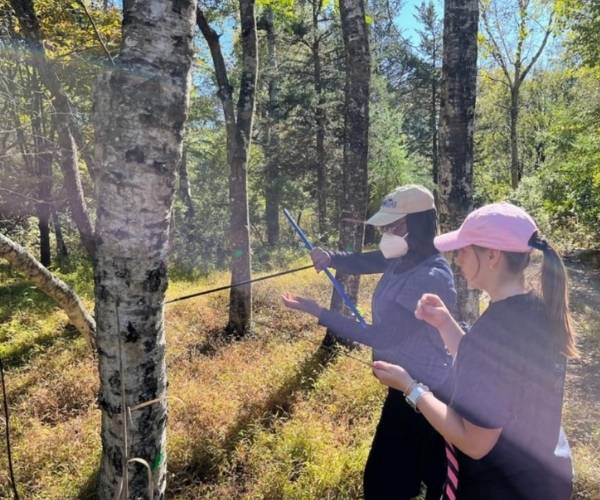
A student taking a tree core sample of Gray Birch at Manresa Island. 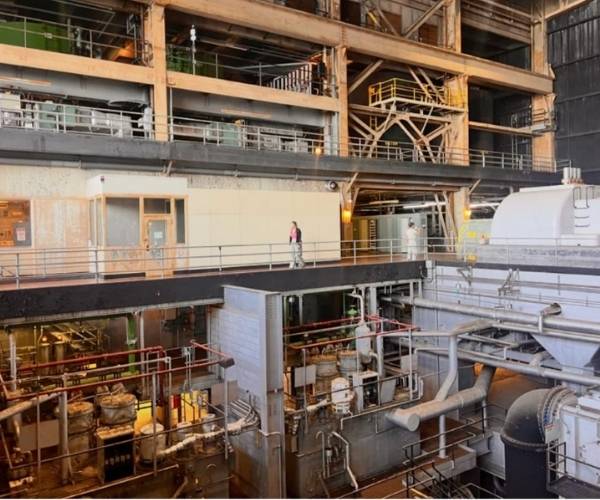
Sasha Volokova, a student in Environmental Arts Research, tours the turbine hall at Manresa Island. 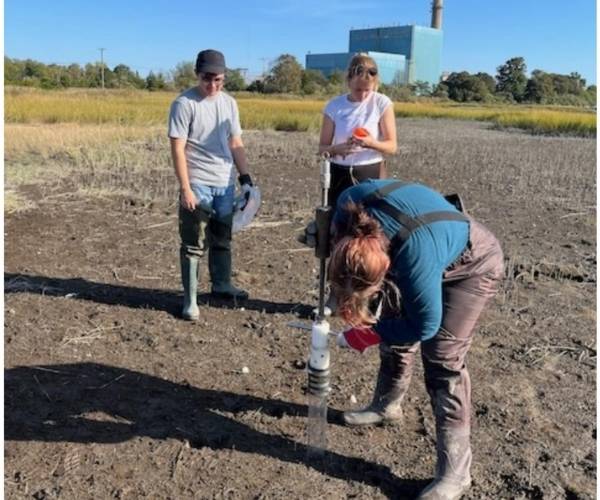
Students collecting sediment cores at Manresa Island. 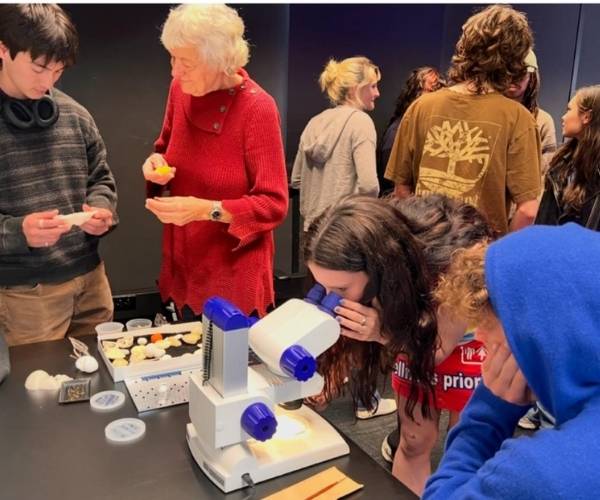
Ellen Thomas leading Environmental Arts Research students in viewing examples of benthic foraminifera, studied as biological indicators in studies of environmental changes in the Long Island Sound. 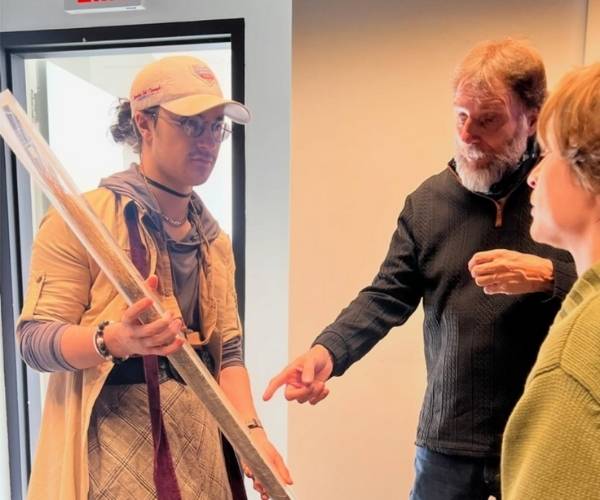
Joop Varekamp explaining a sediment core to members of the Environmental Arts Research class. 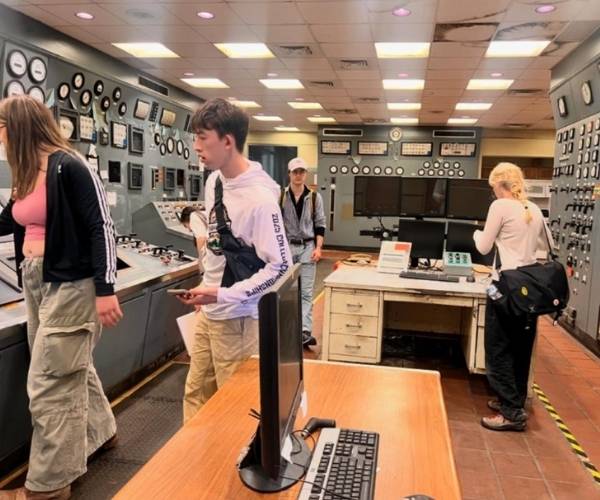
Students explore the control room of the turbine hall at Manresa Island. 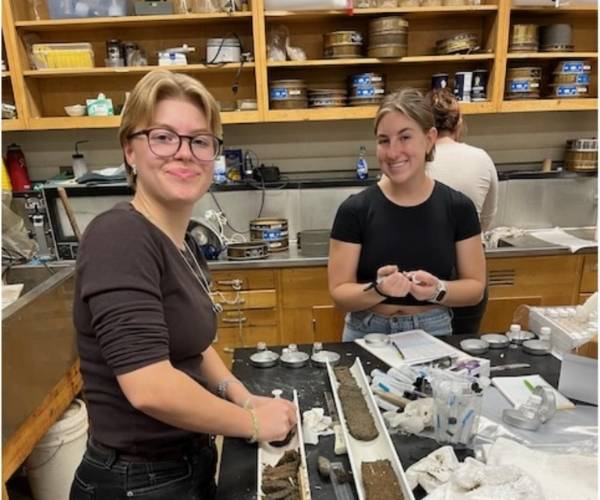
Students preparing a sediment core sample from Manresa Island. 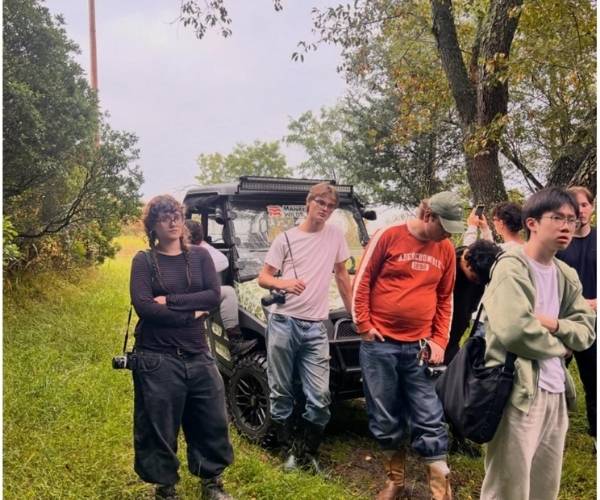
Students exploring the birch forest on disposed coal ash at Manresa Island, with an osprey nest visible in the background. 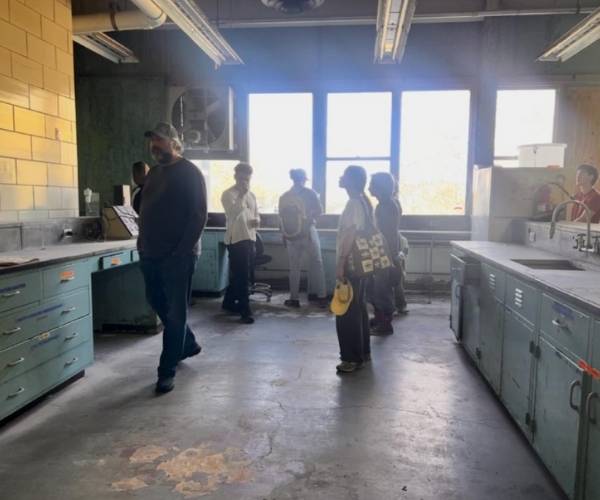
Members of the Environmental Arts Research Group tour the laboratories of the power plant at Manresa Island.
Students in Tim Ku’s Environmental Geochemistry course collected marsh sediment cores that record environmental changes dating back to the mid-1700s. Samples showed prominent mercury spikes, likely tied to regional hat-making industries or other historical sources. Organic matter signatures revealed shifting contributions from low marsh plants, high marsh plants, upland soils, and plankton from Long Island Sound. Tree-ring carbon isotope data from nearby birches may help reconstruct growing conditions during the operational years of the power plant and provide additional context for interpreting the sediment record.
In Environmental Art: Research Through Art / Art Through Research, guided by visiting artist-composer Ari Benjamin Meyers and Courtney Fullilove, students developed site-specific works of art informed by scientific methods. The course featured special visits from emeritus faculty of Earth and Environmental Sciences Joop Varekamp and Ellen Thomas to discuss their decades of foundational research on the Long Island Sound. Student projects included original musical and video compositions, experimental documentary film, proposals for onsite installations, a phytoremediating community garden, and a soundbased work integrating environmental audio, human voices, and sensor data into a dynamic trail-based installation.
The semester’s coursework supports ongoing engagements with Manresa Island as a site for field-based learning and environmental arts research on urban ecologies, bringing together faculty and students from the College of Science and Technology Studies, the Bailey College of the Environment, and the College of Design and Engineering Studies.
This work was supported by the Creative Campus Initiative of the Center for the Arts and a Community Engaged Learning Initiative Grant in the Allbritton Center for the Study of Public Life.