Every year, the Bailey COE awards fellowships to fund summer (and fall and spring) research opportunities for Wesleyan students across all majors and class years. Most recently, the COE awarded more than 30 fellowships to Wes students! Learn about their amazing projects, below!
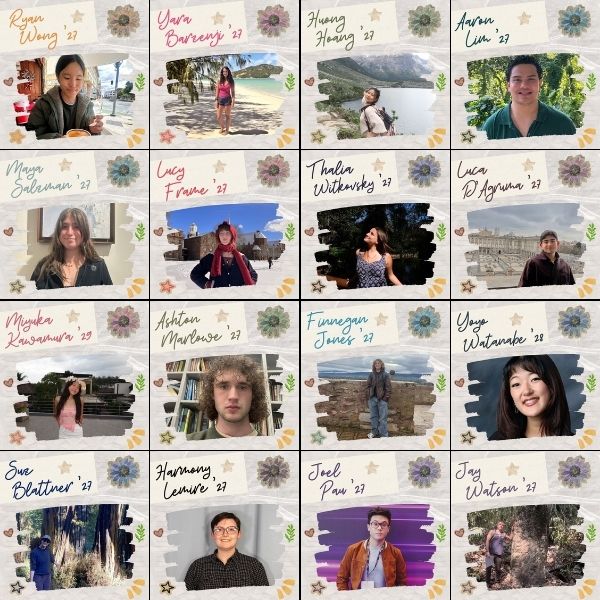
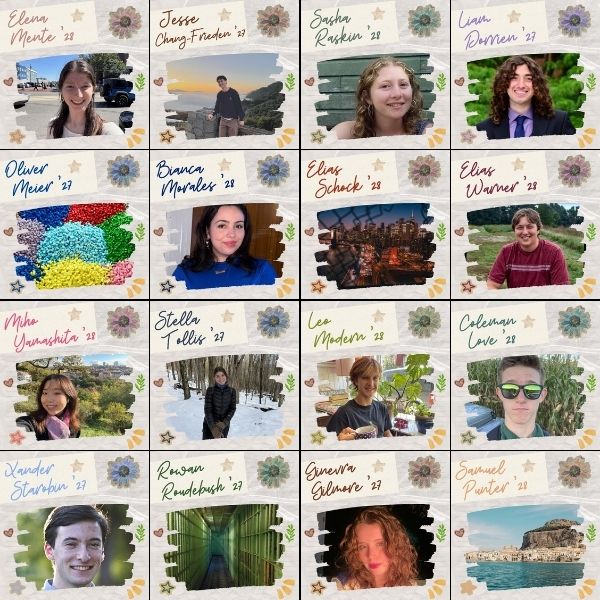
Miyuka Kawamura ‘29
First Year
My project involves creating a documentary that explores how mass tourism is negatively influencing the environment and communities of Phuket, Thailand, through the voices of those who call the island home, including locals, but also the marine animals. Overall, it challenges travellers to rethink what it means to visit paradise responsibly and locals to consider the importance of balancing economic interests with environmental responsibility.
Jesse Chang-Frieden ‘27
E&ES and ENVS
This project uses satellite data to show how trees can cool cities and reduce dangerous heat, especially in neighborhoods most at risk. The results will help cities—starting with Los Angeles—decide where planting trees and adding green infrastructure can most effectively protect people as extreme heat becomes more common.
Yara Barzenji ‘27
E&ES
This project uses wildlife camera trap photos/videos to help protect endangered species by looking beyond where animals are found and exploring whether their health can also be assessed from images. The goal is to make better use of existing data to support conservation without disturbing animals in the wild.
Huong Hoang ‘27
ECON
My project seeks to combine product building with community-engaged research. I will develop a tool to simplify financial reporting for META – Parque Escuela, a grassroots environmental organization in Chile, while researching how reducing administrative burdens can help community groups better sustain and measure their impact.
Maya Salzman ‘27
ENVS/GOVT
This project will investigate how recent increases in drought and wildfire activity from climate change and fire suppression are triggering shifts in forest structure and composition in high elevation forests in the Sierra del Carmen, a remote mountain range in northern Mexico. As climate change and wildfire activity continue to impact forest ecosystems in the Anthropocene, building knowledge of contemporary wildfire impacts is paramount for sustainable forest management along the US-Mexico Borderlands.
Lucy Frame ‘27
ANTH/ARST
I plan to conduct research on Madrid’s okupa movement, in which communities reclaim abandoned buildings and transform them into collectively run social centers that share food, clothing, art supplies, and space. My project documents how these grassroots occupations respond to housing inequality and environmental waste by reusing vacant infrastructure and building sustainable, community-based alternatives to traditional urban development. In light of misrepresentation and a lack of documentation of these centers in the media, I hope to create a positive and transparent ethnography and archive of the space, its events, and the people that give them life and structure.
Ryan Wong ‘27
SOCI/ENVS
This summer, I am investigating the connections between sustainable development and global education in Ecuador and Malaysia. Through ethnographic research with Indigenous activists, educators, development agencies, and community members affected by issues such as land displacement in both countries, I aim to understand how ideas of “sustainable development” justify continued environmental and social inequalities in both countries, shaped by Western colonization and neoliberalization.
Aaron Lim ‘27
GOVT
I seek to investigate the effects of allowing an ethnically distinct minority group a degree of self-governance within a larger national government. Through the lenses of cultural and environmental preservation/protection, equitable distribution of the national budget, and implementing capacity, my goal is to understand how a degree of self-rule affects Indigenous Peoples (IPs) when they are given the autonomy to rule themselves as opposed to a strict adherence to the national government.
Thalia Witkovsky ‘27
ENVS/GOVT
My project is an investigation of the path to electrify and decarbonize the rent stabilized apartments of Stuyvesant Town in the context of city, state, and national programs for affordable and sustainable housing.
Finnegan Jones ‘27
CLST
With the Agora Valley Project I would be excavating a 1st-3rd c. BCE site in Morgantina, Sicily and using our findings to explore questions regarding water management and agricultural developments in a single ancient site over time.
Yoyo Watanabe ‘28
ENVS/GOVT
In my research project, I will interview leaders working on environmental initiatives across several organizations in Southern California to examine the intersection of policy and environmental projects and how the modern policy landscape has influenced their initiatives and organizations. After identifying the findings from the interviews, I will create a presentation to inform the public and the audience at the annual Summit of Jane Goodall Institute’s Roots & Shoots Youth Council US about how the leaders describe what this relationship between policy and environment means in 2026, and any challenges faced and solutions created amidst recent developments.
Suz Blattner ‘27
ENGL
My project is a thesis in creative non-fiction that will explore themes of healing and embodiment through the lens of the Buddhist practice of inter-being. My goal is for my language to help illuminate the collective grief of the earth by writing from my experience of interdependence of all things on earth.
Harmony Lemire ‘27
MB&B/MSB
I propose to study the behavioral mechanism of bird predation that regulates the caterpillar defoliation of white oak trees. I plan to investigate if such bird predation of caterpillars occurs by bird behavioral responses to the density of caterpillars or if it occurs due to chemical cues released from plants due to the presence of caterpillars and specific herbivores, called treehoppers, that feed on the oak’s phloem.
Joel Pau ‘17
ENVS/FILM
This documentary follows the Yurok Tribe as they work to bring the California condor back to Northern California after more than a century of absence. By observing the daily work of species recovery, the film examines what environmental restoration looks like in practice.
Jay Watson ‘27
ARCH/FRNCH
Excavations in a proposed marketplace of traded ancient Maya stone technologies. These excavations will work through a period of Maya history that is hypothesized to have been impacted by ecological disaster and social collapse. Analysis of excavated artifacts for possible evidence of these stressors.
Elena Mente ‘28
CHEM
By the time we will be starting summer research, I will have completed training in Dr. O’Neil’s neurodegenerative disease lab, which has taught basic lab techniques as well as practical knowledge about ALS. Previously I worked in a lab looking at how we measure water hardness for one semester, where I learned valuable skills in asking research questions, searching the literature, and designing experiments.
Liam Dorrien ‘27
GOVT/HISP
In the wake of increasingly destructive natural disasters due to climate change, many private insurance companies have stopped providing coverage in risk-prone areas, including the entire states of California and Florida, leaving government to fill in the gap. My research will focus on how state governments have taken on this new role, its effects on residents in disaster-prone areas, and connection to broader climate governance trends, focusing particularly on California.
Oliver Meier ‘27
CHEM/MB&B
Many plastic products are made of rigid, resilient polymers that cannot be broken down for reuse, contributing to the accumulation of waste. This summer, I plan to continue to research the development and usability of a polymer that maintains this resilience while also containing heat-reactive molecular features that allow for the material’s recyclability.
Xander Starobin ‘27
GOVT/ENVS
My project investigates one potential factor that might influence rural Americans’ support for their state and federal government being more involved in their lives. That factor is local, participatory democracy––the extent to which rural people have power over their local communities through democratic channels.
Samuel Punter ‘28
ARCP
This project investigates how ancient inhabitants of the island of Sicily built massive grain and water storage systems to survive unpredictable droughts. By digging into these ruins, I hope to uncover the story of how societies can adapt to environmental crises, lessons that are still vital in our changing world today.
Ginevra Gilmore ‘27
ARST/IDEAS
I will research the intersection of environmentalism and reproductive rights, considering how collective, societal conceptions of the body, the environment, and ownership influence action and policy. This research project will culminate in an interdisciplinary gallery installation, featuring original ceramic sculptures, digital resources, and archival materials.
Miho Yamashita ‘28
ENVS/GOVT/FGSS
My project investigates whether JICA, Japan’s foreign aid agency, advances gender equality in its water management operations in Jakarta, Indonesia. Leveraging my previous research about Jakarta’s sinking and water scarcity and informed by feminist methodology, I will conduct interviews in Tokyo and Jakarta to understand how foreign aid shapes the everyday experiences of women and outcomes of environmental policies.
Elias Schock ‘28
CSS
I am exploring how climate change is already affecting New York City and why those harms are not experienced equally. By interviewing residents, organizers, and city practitioners and comparing neighborhood infrastructure and policy responses, I will examine how race, income, housing, and public investment shape who is most exposed and who receives protection and support.
Stella Tollis ‘27
BIOL
This proposed research project will investigate how turtle embryos integrate temperature cues during development to drive the decision to eventually differentiate into males or females. Understanding the location of the cells that sense temperature during embryonic development, and the mechanisms by which they operate, will provide more information on how climate change and global warming may affect natural turtle populations.
Elias Warner ‘28
CHEM
My project involves creating efficient solar energy systems to improve and promote the use of renewable solar energy, while reducing the need for harmful, fossil fuel and natural gas-based energy sources.
Rowan Roudebush ‘27
E&ES/FILM
My film explores how trans communities resist the environmental harms of incarceration to build new worlds free of climate crisis and the prison-industrial complex. My GIS investigation offers an easily accessible way for the public to understand the ecological and human toll of New York City Jails, and anticipate the impacts of the new jails being built.
Luca D’Agruma ‘27
HIST
Luca D’Agruma is studying how the Trump administration has used unprecedented government powers to intervene in markets on behalf of the fossil fuel industry and the national security state. Working with labor unions and environmental groups, D’Agruma is helping develop strategies and policy tools that future administrations and state governments can use to support workers and advance climate progress.
Marlowe Ashton ‘27
CHEM
Currently, most solar cells can only utilize about 1/3 of the light available to them; about a third of the light available is lost because the light is too low-energy to be harvested. I will be creating a molecule that will be able to collect low-energy light by combining 2 lower energy beams of light to make one higher-energy beam, which can be used to generate energy.
Bianca Morales ‘28
PHYS
The properties of a crystal called perovskite can potentially make it an excellent candidate material for solar panels. Conducting literature reviews, and physical and chemical analyses of the behavior of perovskite, will prepare the way for upcoming research at Wesleyan University’s Sher Group Lab and improve the material to make it viable for solar panels.
Leo Modern ‘28
ENVS
I will be volunteering/interning at a budding regenerative tree and poultry farm that was severely hurt by DOGE budget cuts. Additionally I will be managing half an acre by myself which I plan to start an heirloom vegetable garden to grow produce for a local homeless shelter.
Sasha Raskin ‘28
CSS/ENVS
I will use qualitative research methods to evaluate how climate change impacts the fishing industry and livelihoods of small business owners on the outer towns of Cape Cod, Massachusetts.
Coleman Love ‘28
BIOL
I will be investigating how insectivorous birds protect white oak trees from caterpillar damage. We predict that bird predation of caterpillars will become more noticeable in the presence of phloem-feeding treehoppers because they increase caterpillar abundance and alter the chemical signals released by the tree in response to caterpillar defoliation. If birds use chemical cues to locate high densities of caterpillar prey, they should have a preference for tree branches with both caterpillars and treehoppers.