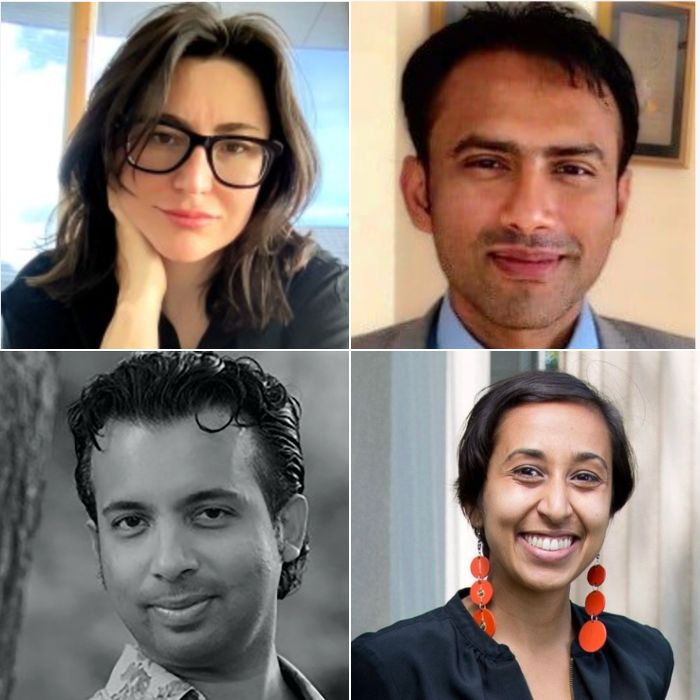
Every academic year, the Bailey COE invites a small group of Wesleyan faculty and undergraduate students, plus a noted scholar from outside the University, to gather together for the Think Tank: a yearlong discussion of a critical environmental issue. The 2025-2026 Bailey COE Think Tank features (left to right, top to bottom) Basak Kus, professor of government; climate policy expert Tim Sahay, assistant research scientist, Johns Hopkins University, and the 2025-26 Menakka and Essel Bailey ’66 Distinguished Visiting Scholar at Wesleyan; Hari Krishnan, Co-Chair, Global South Asian Studies, Professor of Dance; and Mitali Thakor, Assistant Professor of Science and Technology Studies.
Our world is being reshaped by forces such as climate change and the AI revolution, fundamentally altering our relationship with the environment—not only in physical terms but also in political, economic, and cultural ways. These transformations are generating new forms of risk and uncertainty while simultaneously presenting opportunities for innovation, adaptation, and creativity. How do societies conceptualize risk and plan for uncertain futures? How do political actors, scientific experts, and artists interpret and respond to a world defined by overlapping crises and disruptions? What methodologies are being deployed to conceptualize, imagine, quantify, and price risk? How do our understandings of justice evolve as we encounter transformative forces and advocate for more equitable transitions?
In the 2025-2026 academic year, the Bailey COE Think Tank is exploring the themes of disruption, crisis, risk, and uncertain futures. Our world is being reshaped by forces such as climate change and the AI revolution, fundamentally altering our relationship with the environment—not only in physical terms but also in political, economic, and cultural ways. These transformations are generating new forms of risk and uncertainty while simultaneously presenting opportunities for innovation, adaptation, and creativity. How do societies conceptualize risk and plan for uncertain futures? How do political actors, scientific experts, and artists interpret and respond to a world defined by overlapping crises and disruptions? What methodologies are being deployed to conceptualize, imagine, quantify, and price risk? How do our understandings of justice evolve as we encounter transformative forces and advocate for more equitable transitions? In relation to these questions, Professor of Government Basak Kus will work on a book-length project exploring how the US government has understood climate risk since the early 1970s and the role it has assigned to state-based and market-based tools in addressing it. Assistant Professor of Science and Technology Studies Mitali Thakor will work on an interdisciplinary monograph on generative AI in care infrastructures, critically examining the conjoined matrices of nature/artifice and labor capture/value generation under racial technocapitalism via case studies of social robotics programs in the US and the Netherlands. Hari Krishnan will work on a series of movement portraits and choreographic improvisations centered upon the disruptive potential of intimacy, caring and queer love.
Basak Kus
Professor of Government
Tradeoff: Value and Values in the Making of American Climate Policy
The climate change has brought us to a critical juncture. It presents serious challenges to every facet of life from public health and migration to socio-economic security and democratic stability. Governments are compelled to take firm steps to lessen the ecological footprint of economic growth, and integrate climate considerations into their broader public risk management practices. US is no exception. In fact, as one of the most powerful and richest countries in the world with a large carbon footprint, the US bears a substantial responsibility to tackle climate change. My project explores how the US government has understood and tackled climate change as a policy issue from a historical perspective. Through the lens of climate change, it also attempts to enhance our knowledge of American government as a risk manager—the principles that guide it and the policies that constitute it.
I am teaching Capitalism and the Politics of Climate Change: When an Unstoppable Force Meets an Immovable Object in spring 2026. The course explores the complex relationship between capitalism and climate change. In the first part of the course, taking a comparative approach with a primary focus on the US, we begin by examining how capitalism has evolved since the Industrial Revolution, and how various capitalist models have developed worldwide, depending on the role of the state. In the second part, we question the “hegemony of growth” — how growth has been perceived as an indicator of progress and distributive justice — and explore competing visions of green growth and degrowth. In the third part, the course shifts to the political economy of decarbonization. We discuss the history and current realities of carbon dependency, examine cross-national variations in decarbonization efforts, consider the challenging trade-offs, and explore the economic and political factors underlying the struggle over climate policies. Our discussion will also focus on the role of economists and other experts in shaping mitigation efforts.
Hari Krishnan
Co-Chair, Global South Asian Studies, Professor of Dance
Rupture and Disruption: Reflections on “Making” and “Knowing” Dance
I will be working on a series of movement portraits and choreographic improvisations centered upon the disruptive potential of intimacy, caring and queer love. I will be teaching the course, Perspectives in Dance: Queering the Dancing Body: Critical Perspectives on LGBQ Representation. The course focuses on questions of “queering” dance as a historical, cultural, social, and political enterprise. Focusing on both historical and postmodern dance contexts, the course explores key issues around gender and identity, with special reference to the concepts of performativity, impersonation, sexuality, and transformation. The course places the notion of “flows of gender and transformation” at its center, and examines historical, social, and aesthetic shifts in these ideas over the past 50 years. It draws on case studies ranging from female/male dance traditions of impersonation in India, China, Japan, and Indonesia, to postmodern shifts of “classical” dance (such as the all-male cast of Matthew Bourne’s “Swan Lake”) and more popular forms such as voguing and “RuPaul’s Drag Race.”
Mitali Thakor
Assistant Professor of Science and Technology Studies
Generativity & AI: Capture, Extractivism, and Paradoxes of Care
Generative AI seems to signal a “new” frontier in framings of intelligence and capacity, yet its claims and organizing of power tread well-worn paths. Drawing on feminist anthropological insights into the study of “gens,” the etymological root that structures matrices of capture and value generation under technocapitalism, this project critically examines the “generativity” of AI and neural networks, particularly in caregiving settings. Analyzing the neural network as a trope and referential point for political discourse involves dissecting its twinned enactments of nature and artifice in performances of care. Case studies include care robots used in childcare and intimate/sex care settings that rely on artificial neural networks for convincing care simulations, artificial voice and conversational technology, and virtual reality programs to facilitate empathetic and caring relations. Embedded in these case studies are questions of data surveillance and extractivisms: How do AI powerbrokers perform care while despoiling the digital commons? How should we approach the well-documented environmental costs that power genAI’s fantasy of efficiency? How do we reckon with the extraction of racialized labor to train large language models in the name of futures of caregiving? Based on multi-sited ethnographic fieldwork, interviews, and archival study this project plays between the scales of global infrastructure and intimate relations that AI forces us to confront.
In spring 2026 I am teaching AI, Algorithms & Power. This seminar offers an interdisciplinary approach to the study of robotics, cybernetics, and artificial intelligence. The course begins with texts in the history of technology that examine the extraction of labor and environmental resources to power artificial systems under racial capitalism. Students will engage with feminist cyborg studies to consider how categories and classifications of humanity and intelligence have organized techniques of resource extraction. The seminar continues with contemporary scholarship on the constructions of intimacy and affect in social robotics and care infrastructures.
Tim Sahay
Menakka and Essel Bailey ’66 Distinguished Visiting Scholar
In fall 2025, I taught Polycrisis: Investigating Our World Crisis of Ecology, Economics, Empire. Our world crisis of ecology, economics, and empire continues to interact and metastasize in surprising ways. It is shaking confidence in all of our established worldviews and in ruling elites everywhere. People are searching for big, urgent, powerful frames of analysis. This course explored the interdisciplinary frame of polycrisis to characterize the newness, unprecedented scale, and pace of our planetary predicament. What is new and what is old about this polycrisis? Why is there no money for some things and plenty for others? Why is there a return of war? Why are people so angry? What should be done about the escalating ecological and climate crisis? And why, oh why is everyone talking about supply chains and industrial policy? In exploring these questions, we picked up the lens of different academic disciplines, emphasizing their interconnections, with a focus on global political economy, namely the politics of who wins and who loses and how people and nations make justice.